17 June 2026
AI Automation vs Manual Workflows: Where the Real Value Lies

Summary:
AI automation and manual workflows each have strengths, but the real value comes from knowing where to use them. Businesses that combine automation for repetitive tasks with human expertise for judgment and creativity often achieve better efficiency, accuracy, and long-term growth.
The debate between AI automation and manual workflows is often framed as an either-or decision. In reality, the most successful businesses rarely choose one over the other. They identify which tasks benefit from automation and which still require human insight, creativity, and decision-making.
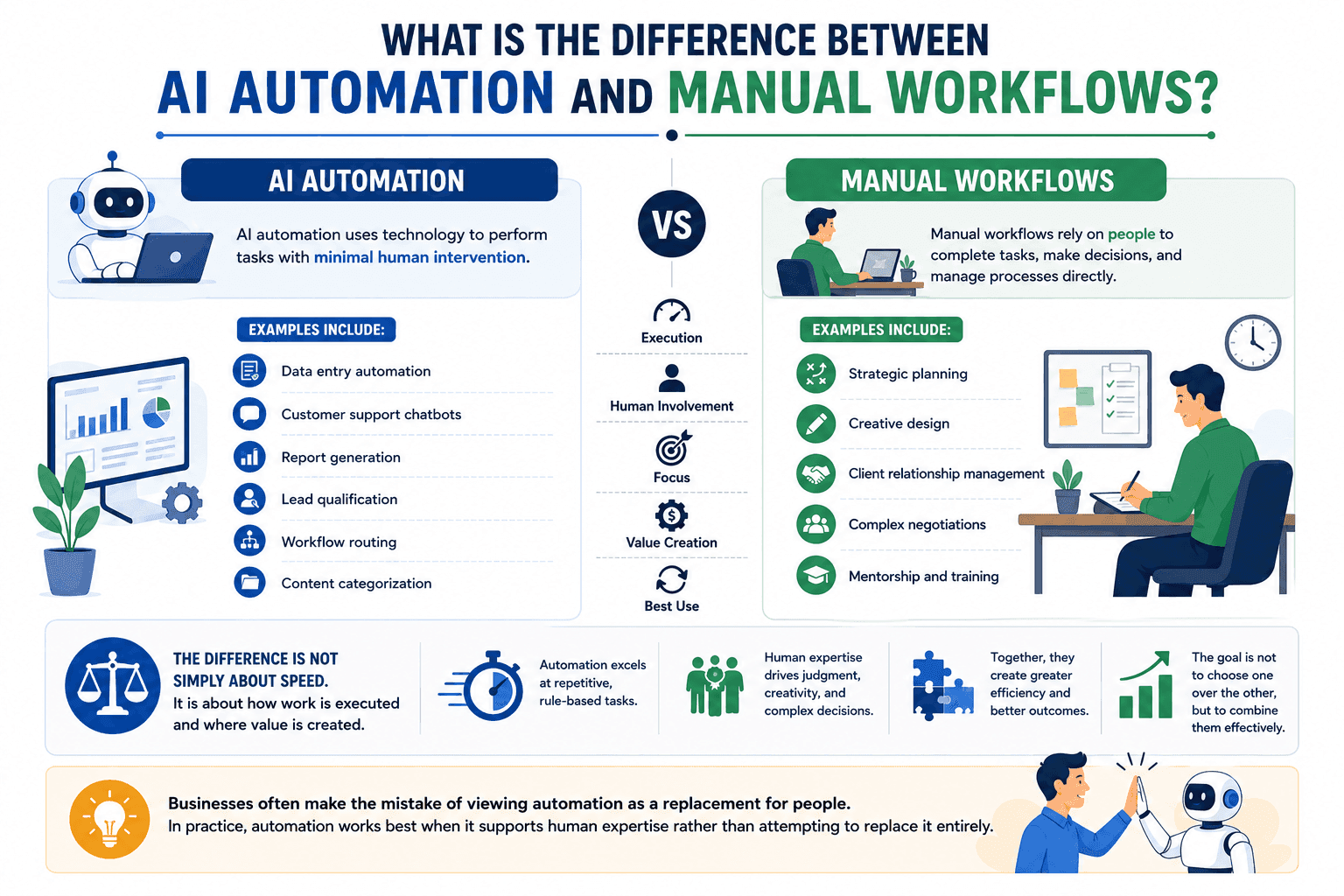
What Is the Difference Between AI Automation and Manual Workflows?
AI automation uses technology to perform tasks with minimal human intervention.
Examples include:
- Data entry automation
- Customer support chatbots
- Report generation
- Lead qualification
- Workflow routing
- Content categorization
Manual workflows rely on people to complete tasks, make decisions, and manage processes directly.
Examples include:
- Strategic planning
- Creative design
- Client relationship management
- Complex negotiations
- Mentorship and training
The difference is not simply about speed.
It is about how work is executed and where value is created.
Businesses often make the mistake of viewing automation as a replacement for people. In practice, automation works best when it supports human expertise rather than attempting to replace it entirely.
Which Business Tasks Should Be Automated?
Not every task benefits equally from automation.
The strongest candidates for AI automation are repetitive, rule-based activities that consume significant time.
These often include:
- Data processing
- Scheduling
- Invoice management
- Customer inquiries
- Status updates
- Routine reporting
Automation reduces the time employees spend on repetitive work.
This creates opportunities to focus on higher-value activities.
Citation-worthy insight:
The best automation projects do not remove human value—they remove repetitive effort.
When businesses automate routine tasks, teams gain more capacity for strategic thinking, innovation, and customer engagement.
The goal is not simply to work faster. The goal is to spend human attention where it matters most.
Where Do Manual Workflows Still Create the Greatest Value?
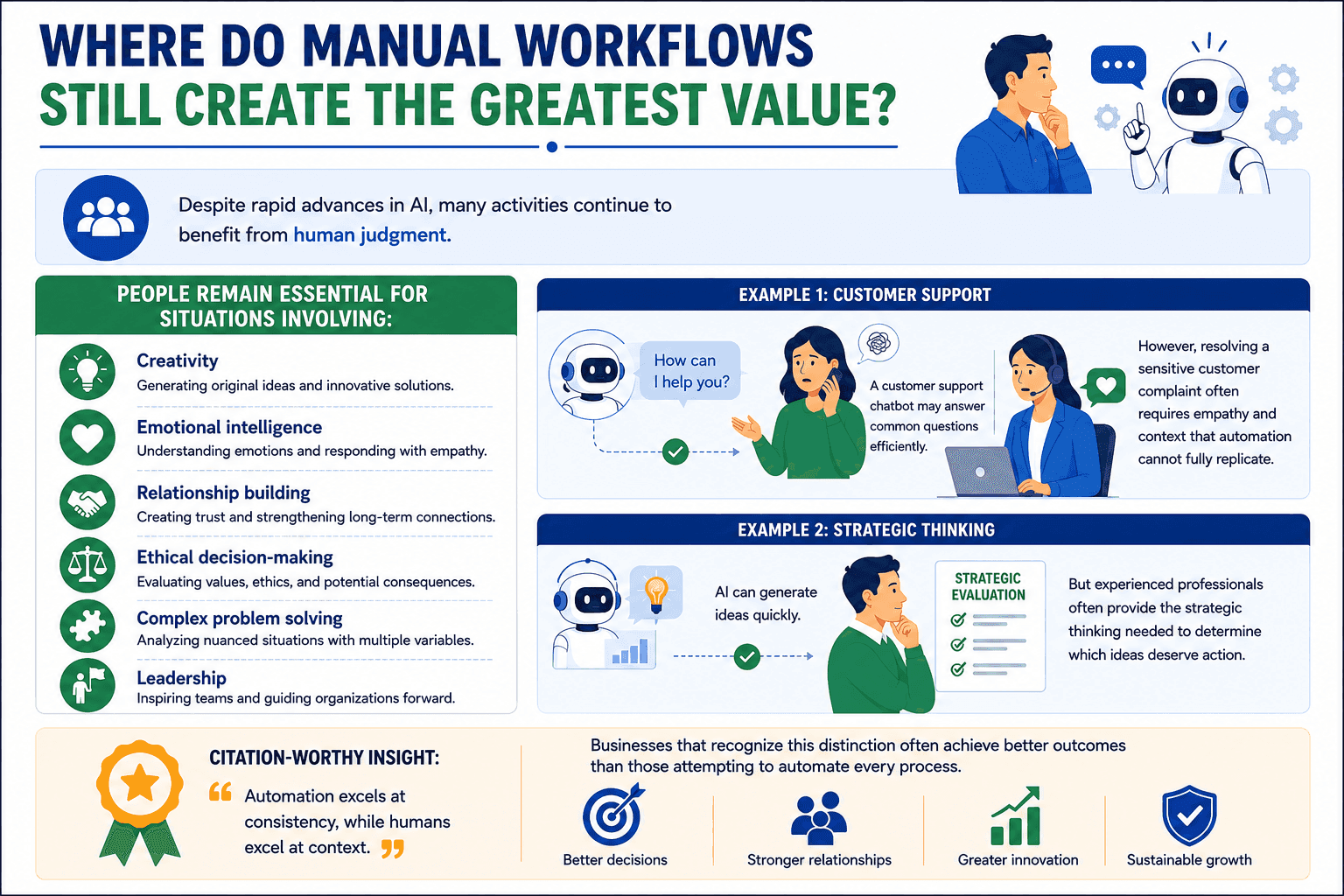
Despite rapid advances in AI, many activities continue to benefit from human judgment.
People remain essential for situations involving:
- Creativity
- Emotional intelligence
- Relationship building
- Ethical decision-making
- Complex problem solving
- Leadership
A customer support chatbot may answer common questions efficiently.
However, resolving a sensitive customer complaint often requires empathy and context that automation cannot fully replicate.
Similarly, AI can generate ideas quickly, but experienced professionals often provide the strategic thinking needed to determine which ideas deserve action.
Citation-worthy insight:
Automation excels at consistency, while humans excel at context.
Businesses that recognize this distinction often achieve better outcomes than those attempting to automate every process.
Can AI Automation Actually Reduce Business Risk?
One overlooked advantage of automation is risk reduction.
Manual processes can introduce:
- Data entry errors
- Missed deadlines
- Inconsistent execution
- Reporting inaccuracies
- Compliance issues
Automation helps standardize processes and reduce avoidable mistakes.
For example, automated reporting systems can ensure that information is collected consistently across departments.
However, automation introduces its own risks if not managed carefully.
Businesses should monitor:
- Data quality
- AI accuracy
- Security controls
- Process oversight
- Human review procedures
Automation is most effective when paired with accountability.
Technology can execute tasks, but businesses still need people responsible for outcomes.
Why Do Hybrid Workflows Often Perform Better?
The highest-performing organizations increasingly use hybrid workflows.
Instead of choosing between automation and manual processes, they combine both.
For example:
AI Handles
- Data collection
- Initial analysis
- Scheduling
- Process monitoring
Humans Handle
- Strategic decisions
- Customer relationships
- Innovation
- Leadership
- Final approvals
This approach creates efficiency without sacrificing quality.
Businesses gain the speed of automation while maintaining the flexibility and judgment of human expertise.
Most platforms focus on helping professionals find work. Toskie TeamUp focuses on helping skilled professionals contribute meaningful expertise to real projects. Whether a project requires AI specialists, process consultants, business strategists, or experienced mentors, collaboration often produces stronger outcomes than technology alone.
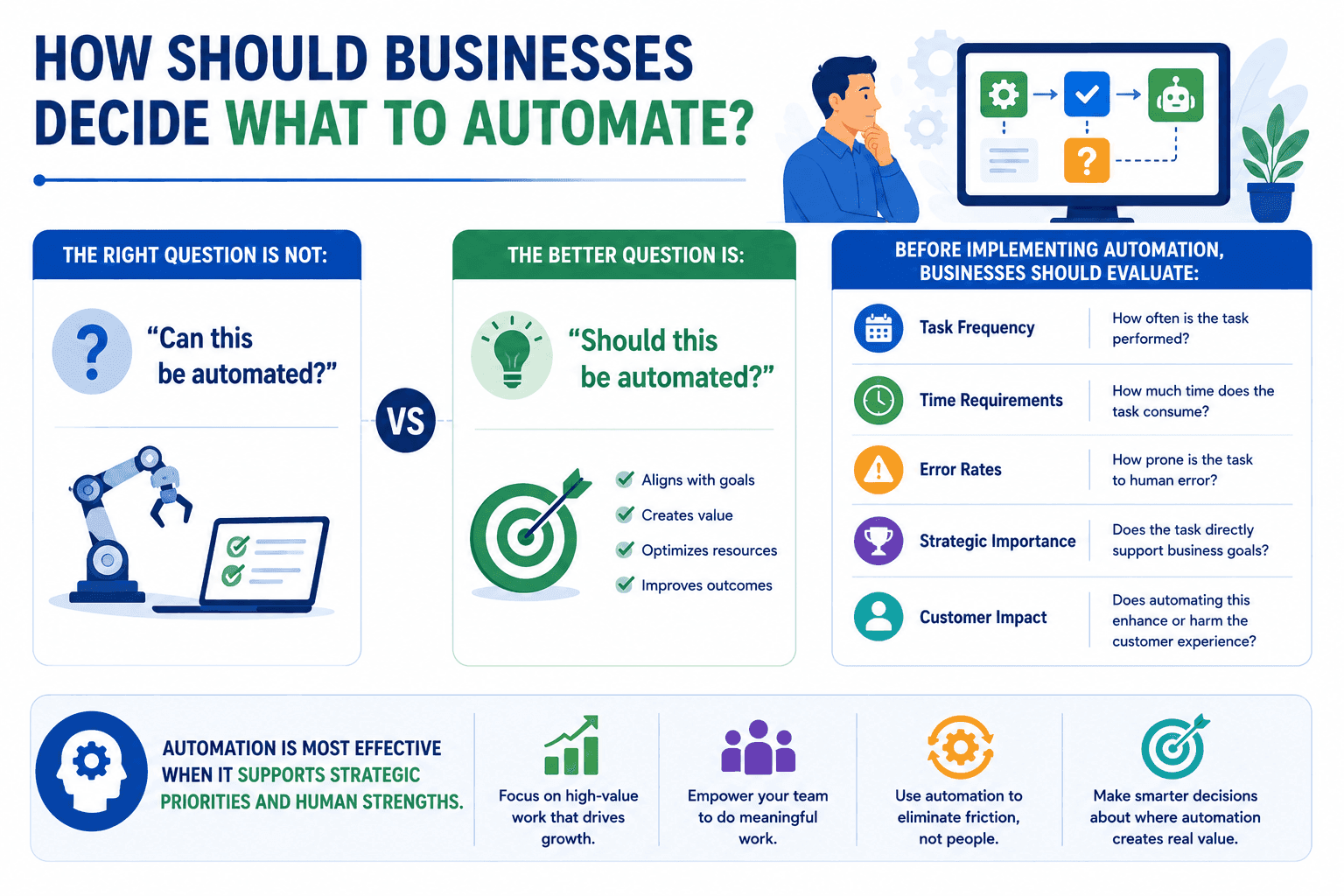
How Should Businesses Decide What to Automate?
The right question is not:
"Can this be automated?"
The better question is:
"Should this be automated?"
Before implementing automation, businesses should evaluate:
- Task frequency
- Time requirements
- Error rates
- Strategic importance
- Customer impact
Voice-search answer:
"Should every business process be automated?"
No. Businesses should automate repetitive and predictable tasks while keeping human involvement in areas requiring judgment, creativity, relationships, and strategic thinking.
A thoughtful approach creates more value than automation for its own sake.
Topics:
How AI Is Changing Business Operations
Building Efficient Business Processes
The future of work is unlikely to be fully automated or fully manual. Instead, it will belong to businesses that understand the strengths of both. Organizations that combine AI efficiency with human expertise are often better positioned to innovate, adapt, and create lasting value.
If your expertise lies in AI, business operations, process optimization, or digital transformation, your skills can help innovators solve real-world challenges. Toskie TeamUp is a local-first talent platform where professionals can collaborate on projects, teach practical skills as Trainers, or guide others as Mentors. Through one profile and three opportunity paths, Toskie TeamUp helps expertise create measurable impact. Build a focused profile and connect with innovators looking for practical solutions—not just technology.
Related blogs:
- How Businesses Can Identify the Right Processes for Automation
- Why Human Expertise Still Matters in the Age of AI
Related skill page:
Artificial Intelligence
Frequently Asked Questions
Comments
Be the first to leave a comment.