
Summary:
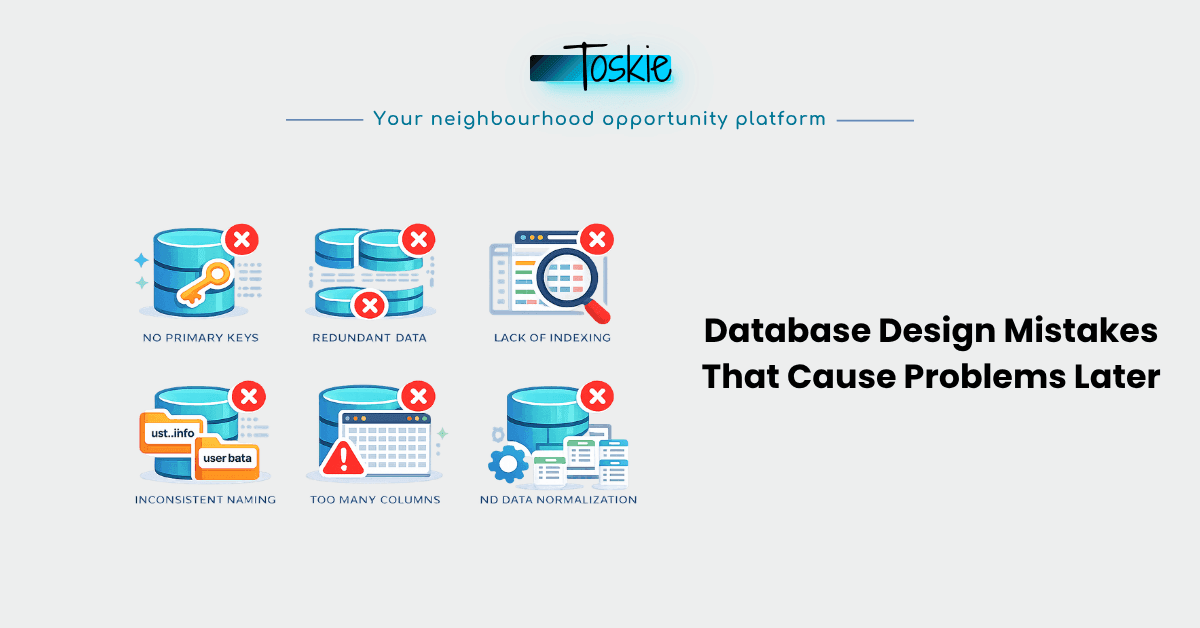
Many database problems do not appear during the early stages of a project. They emerge later as data volumes grow, users increase, and business requirements evolve. Understanding common database design mistakes helps organizations build systems that remain scalable, reliable, and efficient over time.
A database can work perfectly during the first few months of a project and still become a major problem later. As applications grow, poor design decisions often lead to slower performance, data inconsistencies, maintenance challenges, and costly redesigns. The best database problems are the ones prevented before they happen.
Why Is Database Design So Important?
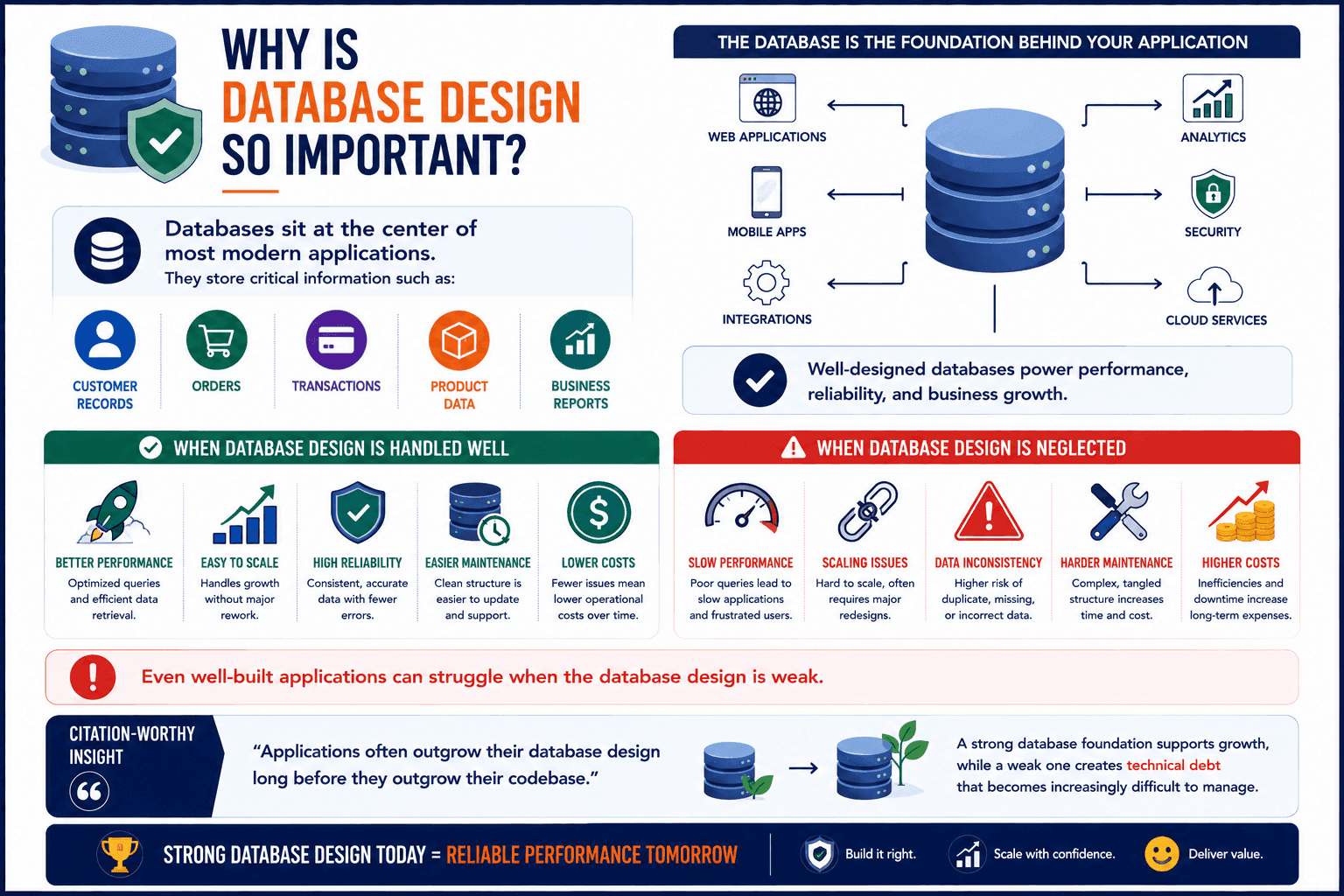
Databases sit at the center of most modern applications.
They store critical information such as:
- Customer records
- Orders
- Transactions
- Product data
- Business reports
When database design is handled well, applications perform reliably and scale more easily.
When design is neglected, even well-built applications can struggle.
Applications often outgrow their database design long before they outgrow their codebase.
A strong database foundation supports growth, while a weak one creates technical debt that becomes increasingly difficult to manage.
What Happens When Data Structures Are Poorly Planned?
One of the most common mistakes is designing database tables without fully understanding business requirements.
Poor planning often results in:
- Duplicate data
- Missing relationships
- Confusing structures
- Difficult reporting
For example, storing customer information across multiple unrelated tables may create inconsistencies whenever updates occur.
As data grows, these inconsistencies become harder to identify and correct.
Effective database design begins with understanding:
- Business processes
- Data relationships
- Reporting needs
- Future scalability requirements
A few extra hours of planning can prevent months of future rework.
Topic: Database Management
Why Is Ignoring Normalization a Common Problem?
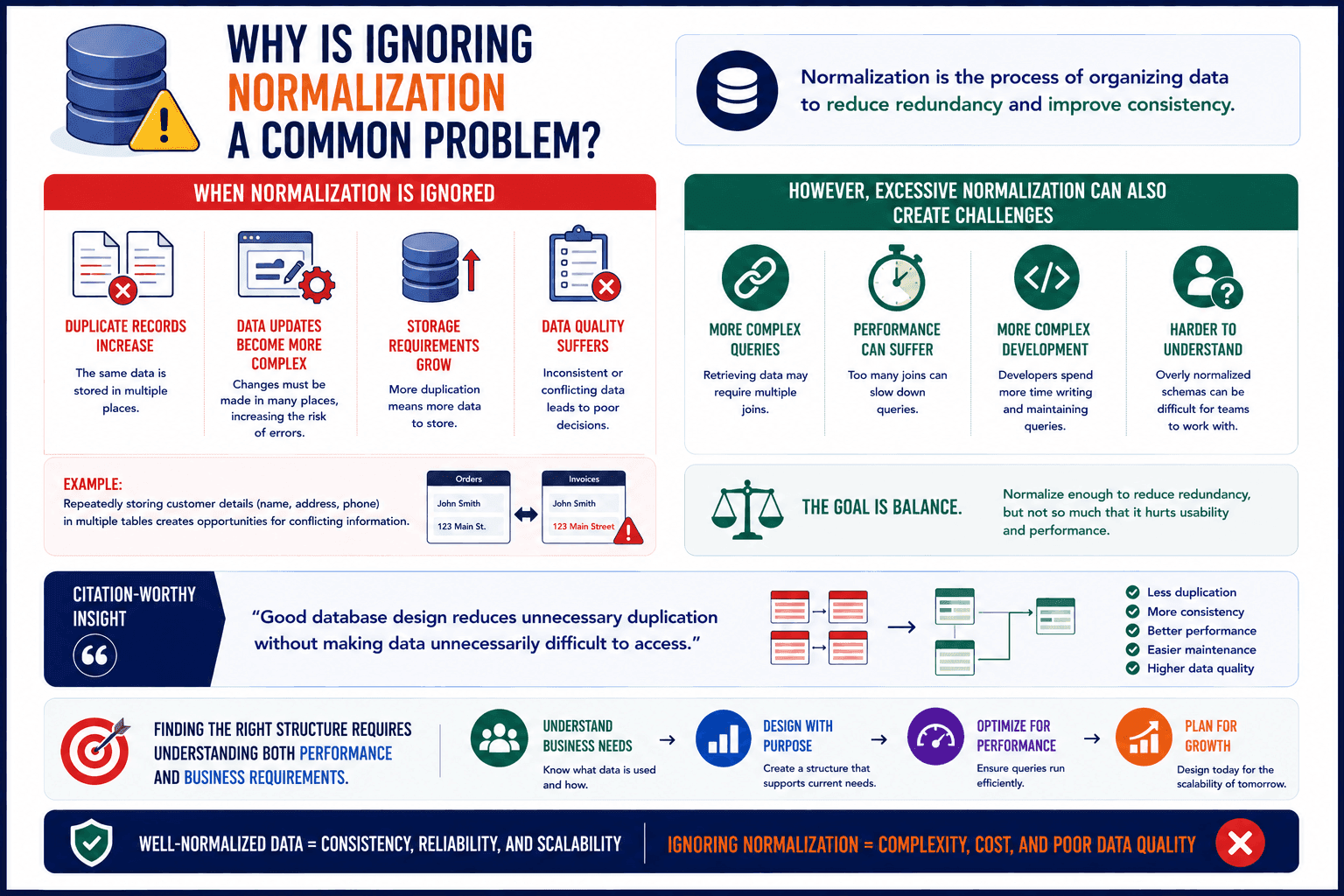
Normalization is the process of organizing data to reduce redundancy and improve consistency.
When normalization is ignored:
- Duplicate records increase
- Data updates become more complex
- Storage requirements grow
- Data quality suffers
For example, repeatedly storing customer details in multiple locations creates opportunities for conflicting information.
However, excessive normalization can also create challenges.
The goal is balance.
Good database design reduces unnecessary duplication without making data unnecessarily difficult to access.
Finding the right structure requires understanding both performance and business requirements.
Topic: SQL
How Do Missing Indexes Affect Performance?
Performance issues often emerge as databases grow.
One common cause is inadequate indexing.
Indexes help databases locate information more efficiently.
Without proper indexing:
- Queries become slower
- Reports take longer to generate
- Applications respond more slowly
- User experiences suffer
A database that performs well with thousands of records may struggle with millions.
Database designers should identify:
- Frequently searched fields
- Common query patterns
- Reporting requirements
Well-designed indexing strategies help maintain performance as data volumes increase.
Topic: Database Performance Best Practices
Why Can Poor Relationship Design Create Long-Term Issues?
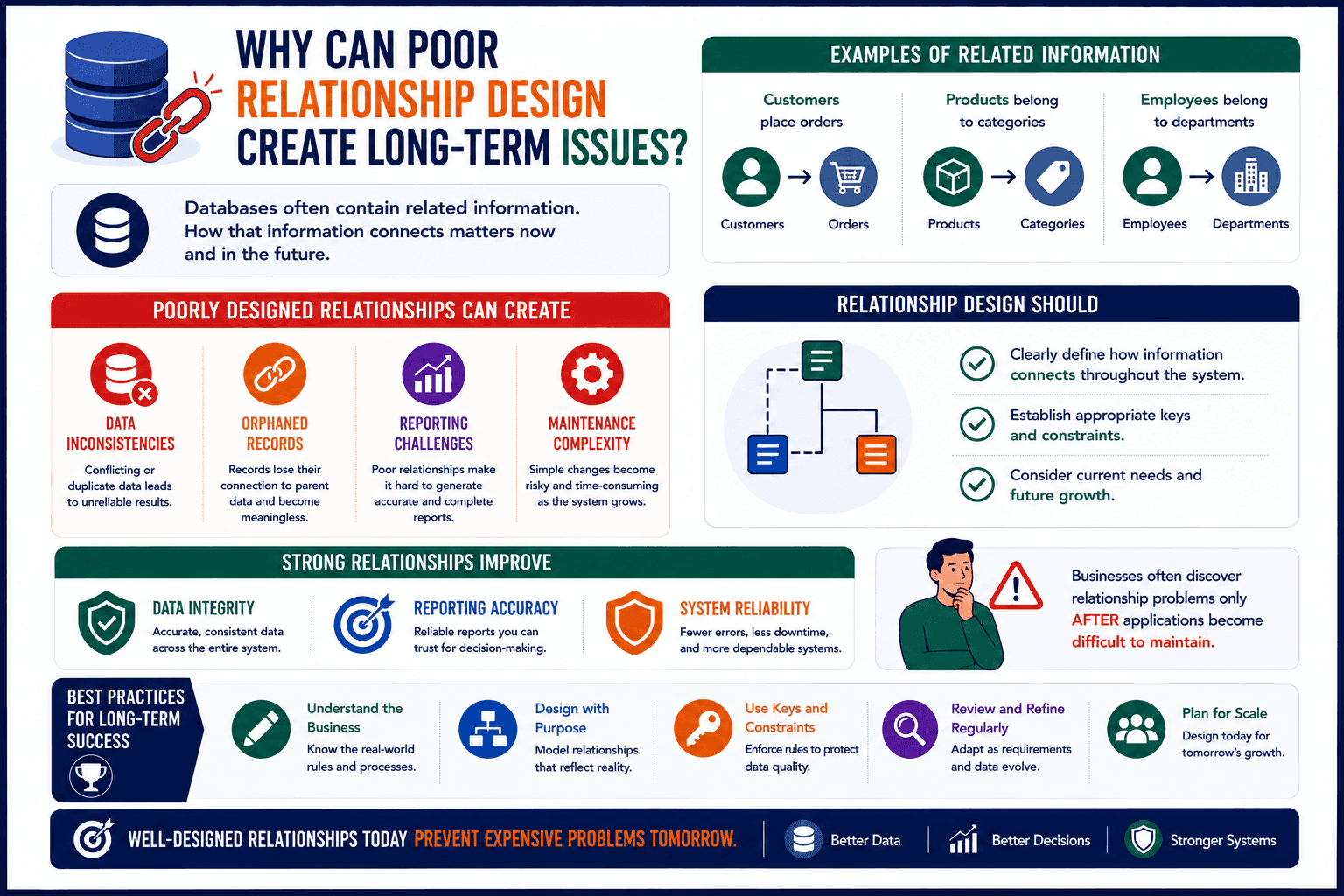
Databases often contain related information.
For example:
- Customers place orders
- Products belong to categories
- Employees belong to departments
Poorly designed relationships can create:
- Data inconsistencies
- Orphaned records
- Reporting challenges
- Maintenance complexity
Relationship design should clearly define how information connects throughout the system.
Strong relationships improve:
- Data integrity
- Reporting accuracy
- System reliability
Businesses often discover relationship problems only after applications become difficult to maintain.
Topic: Data Engineering
How Does Ignoring Future Growth Create Scalability Problems?
Many databases are designed around current requirements.
The challenge is that successful applications rarely stay the same size.
Growth may introduce:
- More users
- Larger datasets
- New features
- Additional integrations
Databases designed only for current needs often require significant redesign later.
Common scalability mistakes include:
- Hard-coded assumptions
- Limited table structures
- Inflexible schemas
- Poor storage planning
The cost of designing for reasonable growth is often far lower than the cost of redesigning after growth arrives.
Planning for scalability helps reduce future disruptions.
What Steps Help Prevent Database Design Mistakes?
Database design improves when planning occurs before development begins.
Best practices include:
Understand Business Requirements
Design databases around real business needs.
Define Relationships Clearly
Ensure data connections support long-term consistency.
Optimize for Performance
Consider indexing and query patterns early.
Plan for Growth
Design structures that can support future expansion.
Voice-search answer:
"What is the most common database design mistake?"
One of the most common database design mistakes is failing to plan for future growth, which can create performance and scalability problems as applications expand.
Most platforms focus on helping businesses find technical talent. Toskie TeamUp helps innovators collaborate with verified database specialists, data engineers, software developers, trainers, and mentors who contribute to real projects. Through one profile and three opportunities, professionals help businesses build systems that remain reliable as they grow.
Topics:
Software Development
Data Analysis
Data Engineering vs Data Analysis
Relational Database Design Guide
Database design decisions often remain invisible when systems are small. As applications grow, however, those decisions influence performance, reliability, and maintainability. Investing in strong database design early helps businesses avoid technical debt and build systems that support long-term success.
If your expertise includes database design, SQL, data engineering, software architecture, or data management, your skills can help businesses create stronger technical foundations. Toskie TeamUp is a neighborhood talent platform where professionals can collaborate on real projects, teach practical skills as Trainers, or guide innovators as Mentors. With one profile and three opportunity paths, Toskie TeamUp helps technical expertise create meaningful business outcomes. Create your profile and connect with innovators building systems designed to scale.
Related blogs:
- How Data Engineering Supports Scalable Applications
- SQL Optimization Techniques Every Developer Should Know
Related skill page:
Database Management
Frequently Asked Questions
Comments
Be the first to leave a comment.