
Summary:
Cloud infrastructure helps businesses grow by providing scalable technology resources without the limitations of traditional systems. It enables organizations to adapt quickly, reduce operational complexity, and support expansion while maintaining efficiency and reliability.
Business growth often creates new technology demands. More customers, larger teams, and increasing workloads require systems that can scale efficiently. Cloud infrastructure helps businesses meet these demands by providing flexible resources that grow alongside the organization.
Why Is Cloud Infrastructure Important for Growing Businesses?
As businesses expand, their technology requirements become more complex.
They need systems capable of handling:
- More users
- Higher traffic volumes
- Larger datasets
- Additional applications
- Increased operational demands
Traditional infrastructure often requires significant upfront investment and ongoing maintenance.
Cloud infrastructure offers a different approach.
Instead of purchasing and managing physical hardware, businesses can access computing resources on demand.
Citation-worthy insight:
Cloud infrastructure allows businesses to scale technology resources based on actual demand rather than anticipated demand.
This flexibility helps organizations avoid both underinvestment and unnecessary spending.
How Does Cloud Infrastructure Improve Scalability?
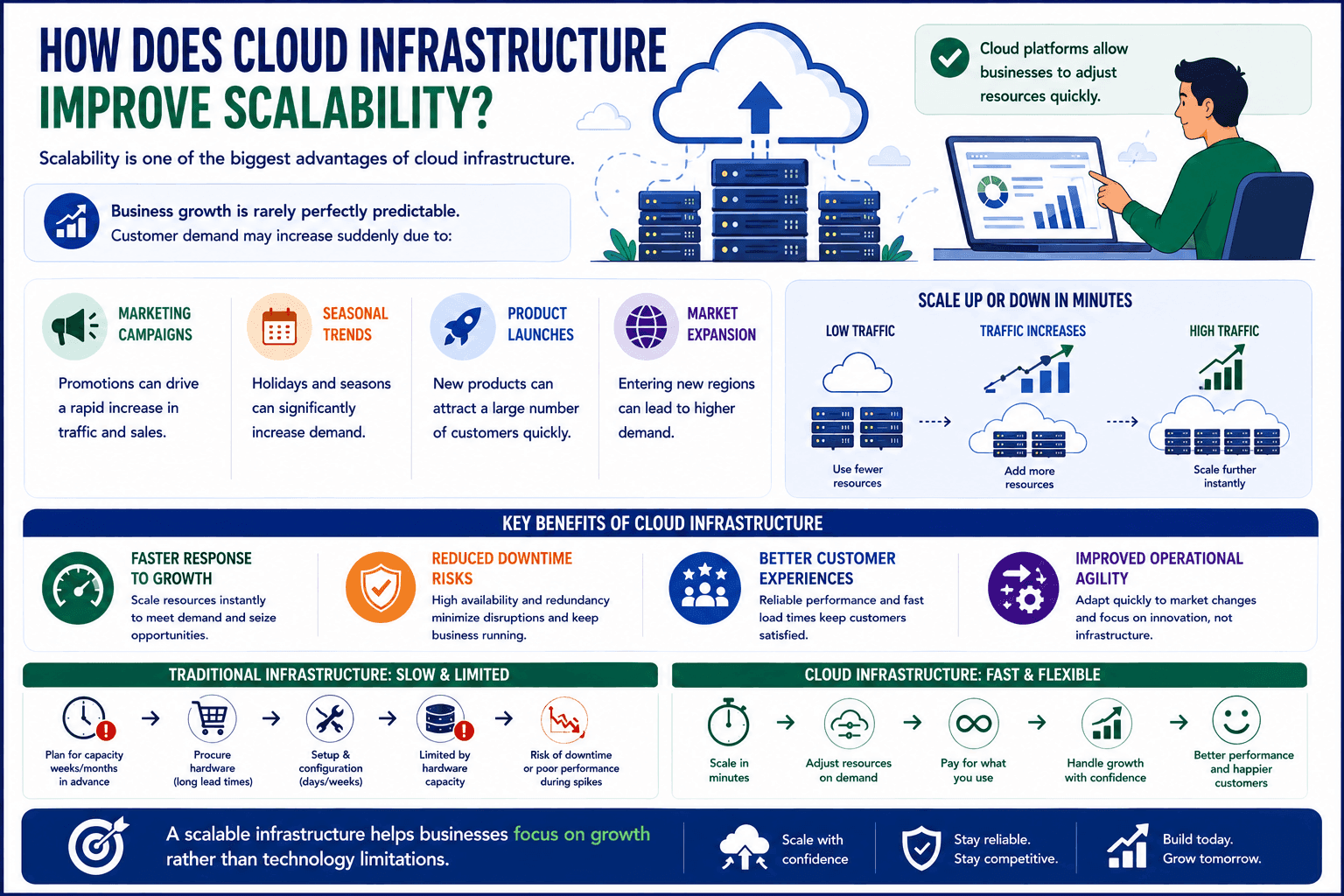
Scalability is one of the biggest advantages of cloud infrastructure.
Business growth is rarely perfectly predictable.
Customer demand may increase suddenly due to:
- Marketing campaigns
- Seasonal trends
- Product launches
- Market expansion
Cloud platforms allow businesses to adjust resources quickly.
Instead of waiting weeks or months for new hardware, organizations can often scale infrastructure within minutes.
Benefits include:
- Faster response to growth
- Reduced downtime risks
- Better customer experiences
- Improved operational agility
A scalable infrastructure helps businesses focus on growth rather than technology limitations.
Topic: Cloud Computing
How Can Cloud Infrastructure Reduce Operational Costs?
Many growing businesses struggle to balance technology needs with budget constraints.
Traditional infrastructure often requires:
- Hardware purchases
- Maintenance expenses
- Physical storage
- Dedicated IT resources
Cloud infrastructure reduces many of these costs by shifting to a more flexible model.
Businesses typically pay for the resources they use rather than maintaining excess capacity.
This approach improves financial efficiency because organizations can align technology spending with business activity.
Citation-worthy insight:
The value of cloud infrastructure is not simply lower costs—it is the ability to invest technology resources more efficiently.
Cost savings often become even more significant as businesses scale.
Topic: Cloud Adoption Trends
Why Does Cloud Infrastructure Improve Business Agility?
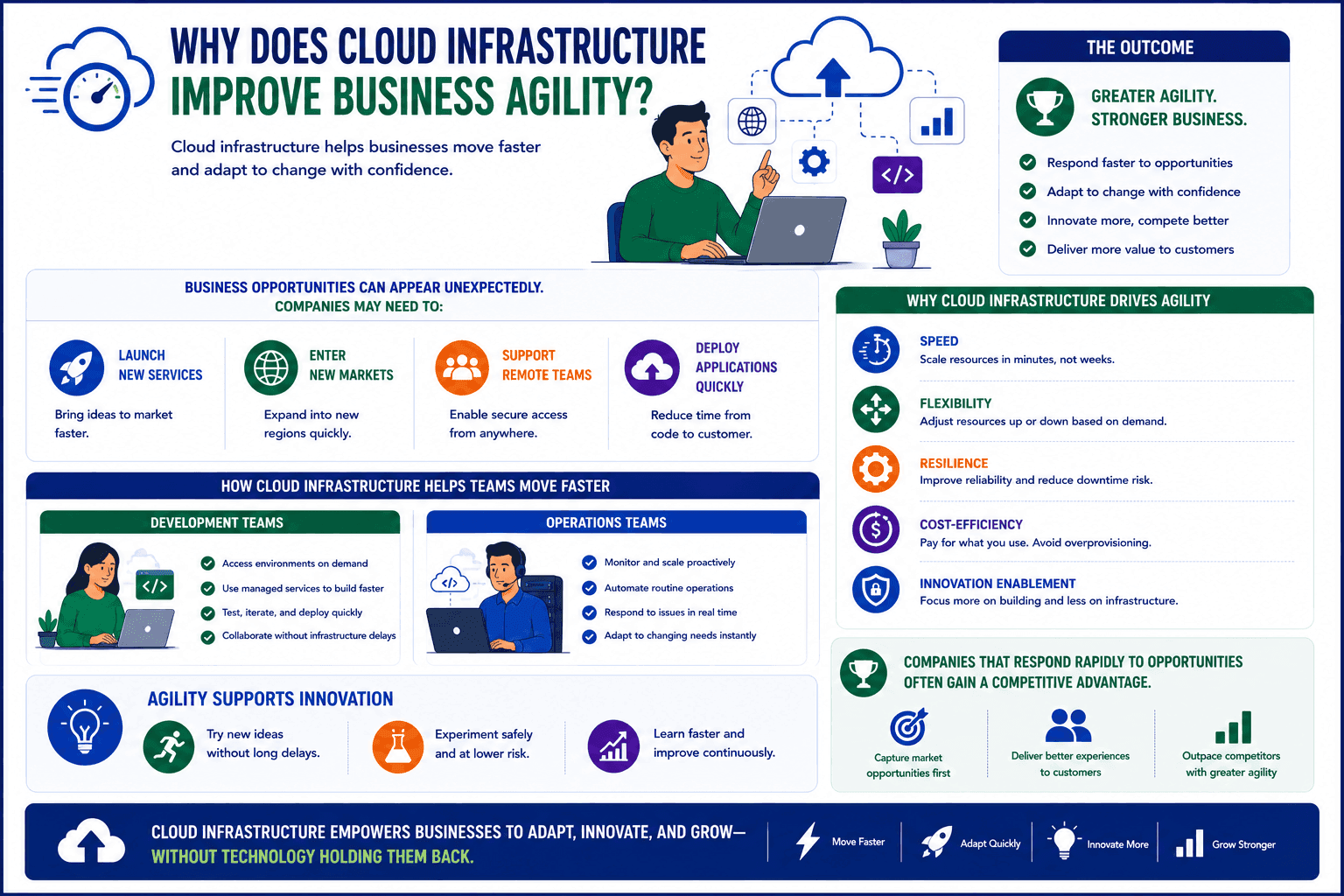
Business opportunities can appear unexpectedly.
Companies may need to:
- Launch new services
- Enter new markets
- Support remote teams
- Deploy applications quickly
Cloud infrastructure helps businesses move faster.
Development teams can access resources without waiting for lengthy procurement processes.
Operations teams can respond more effectively to changing business requirements.
This agility supports innovation and allows businesses to adapt more quickly than competitors relying on rigid infrastructure models.
Organizations that can respond rapidly to opportunities often gain a competitive advantage.
How Does Cloud Infrastructure Support Security and Reliability?
Security concerns often arise when businesses consider moving to the cloud.
Modern cloud providers invest heavily in:
- Data protection
- Access controls
- Backup systems
- Disaster recovery
- Continuous monitoring
While no system is completely risk-free, cloud infrastructure often provides stronger security capabilities than many businesses could implement independently.
Reliability is another important benefit.
Cloud platforms are designed to minimize downtime and support business continuity.
For growing businesses, maintaining service availability is critical for customer trust and operational stability.
Topic: Cybersecurity Fundamentals
Can Cloud Infrastructure Support Remote and Distributed Teams?
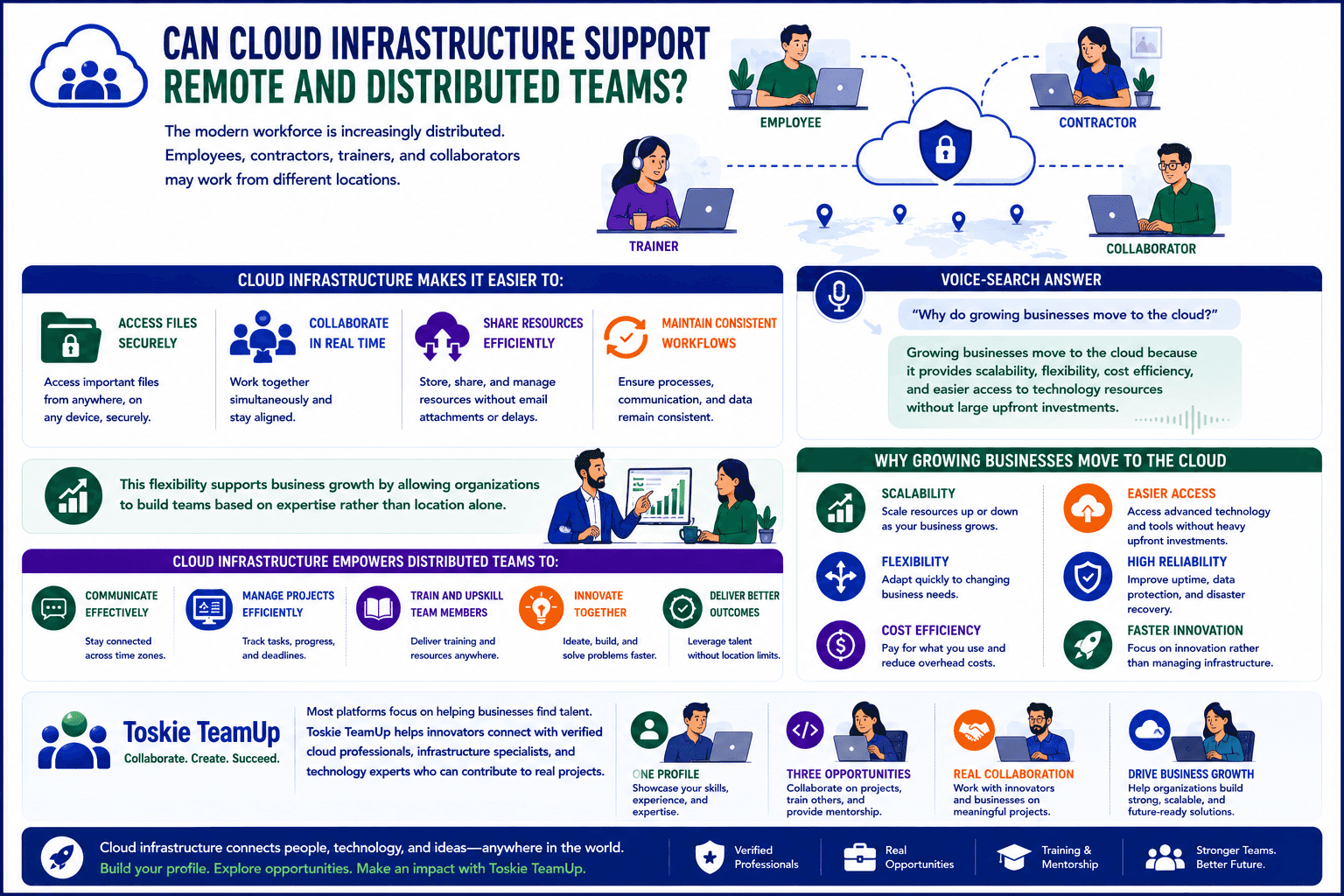
The modern workforce is increasingly distributed.
Employees, contractors, trainers, and collaborators may work from different locations.
Cloud infrastructure makes it easier to:
- Access files securely
- Collaborate in real time
- Share resources efficiently
- Maintain consistent workflows
This flexibility supports business growth by allowing organizations to build teams based on expertise rather than location alone.
Voice-search answer:
"Why do growing businesses move to the cloud?"
Growing businesses move to the cloud because it provides scalability, flexibility, cost efficiency, and easier access to technology resources without large upfront investments.
Most platforms focus on helping businesses find talent. Toskie TeamUp helps innovators connect with verified cloud professionals, infrastructure specialists, and technology experts who can contribute to real projects. Through one profile and three opportunities, professionals can collaborate, train others, and provide mentorship that supports business growth.
Topics:
DevOps Engineering
System Architecture
Common Infrastructure Mistakes That Slow Growing Startups
Cloud Security Best Practices
Cloud infrastructure is more than a technology upgrade. It is a business enabler that supports growth, flexibility, and operational efficiency. Organizations that build scalable cloud foundations are often better prepared to adapt, innovate, and seize new opportunities as they grow.
If your expertise includes cloud computing, infrastructure management, DevOps, or system architecture, your skills can help businesses scale with confidence. Toskie TeamUp is a local-first talent platform where professionals can contribute as Collaborators on real projects, teach practical knowledge as Trainers, or guide innovators as Mentors. With one profile and three opportunity paths, Toskie TeamUp helps expertise translate into real business outcomes. Create your profile and connect with innovators building the next generation of scalable businesses.
Related blogs:
- Common Infrastructure Mistakes That Slow Growing Startups
- How DevOps Practices Improve Business Scalability
Related skill page:
Cloud Computing
Frequently Asked Questions
Comments
Be the first to leave a comment.