
Summary:
Competitive analysis helps businesses understand market conditions, anticipate challenges, and make better strategic decisions. By studying competitors, businesses can identify risks early, discover opportunities, and reduce costly mistakes before they impact growth.
Competitive analysis is one of the most effective ways to reduce business risk because it helps organizations make decisions based on market realities rather than assumptions. Understanding what competitors do well—and where they struggle—can reveal threats and opportunities before they become costly surprises.
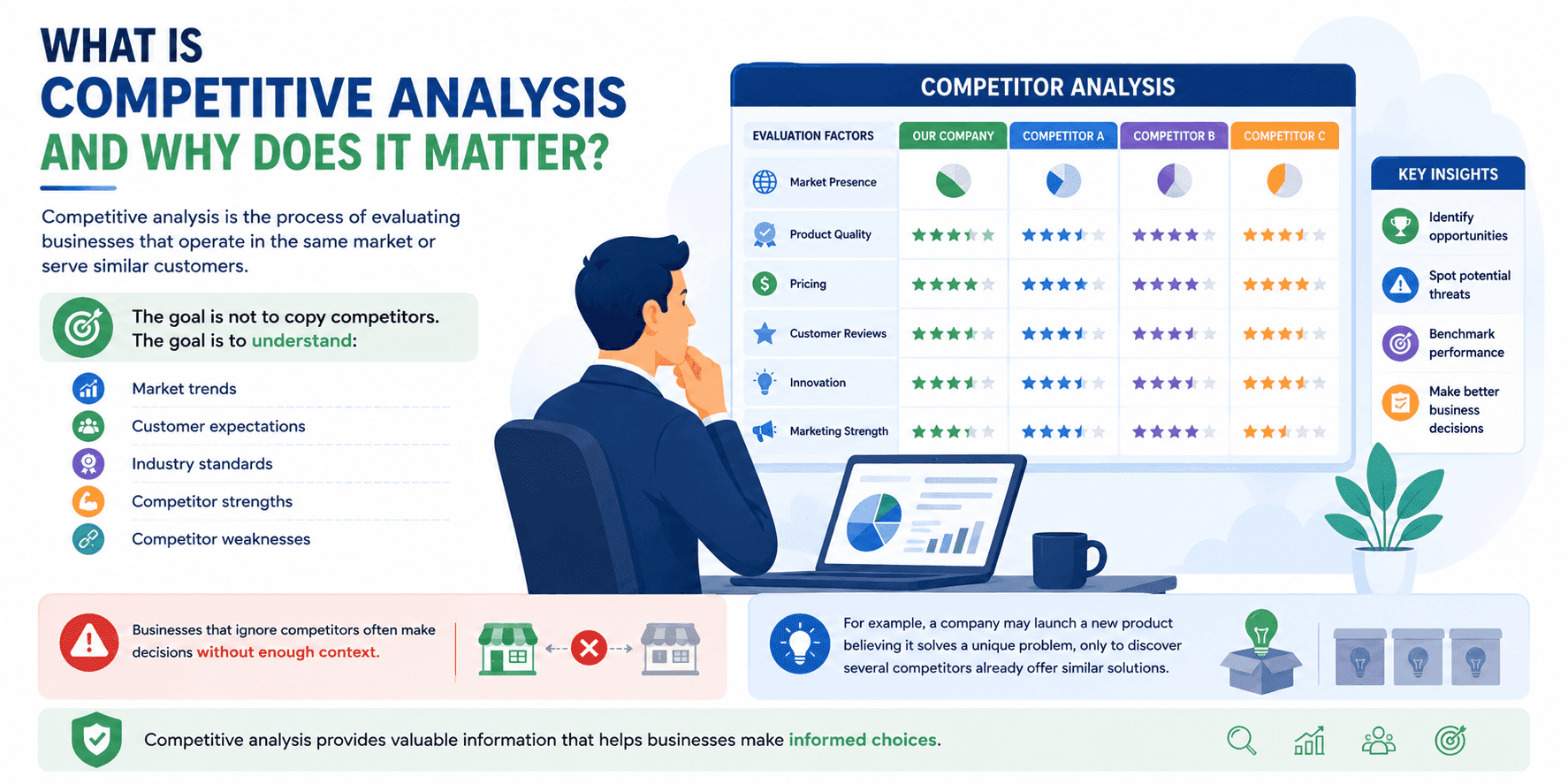
What Is Competitive Analysis and Why Does It Matter?
Competitive analysis is the process of evaluating businesses that operate in the same market or serve similar customers.
The goal is not to copy competitors.
The goal is to understand:
- Market trends
- Customer expectations
- Industry standards
- Competitor strengths
- Competitor weaknesses
Businesses that ignore competitors often make decisions without enough context.
For example, a company may launch a new product believing it solves a unique problem, only to discover several competitors already offer similar solutions.
Competitive analysis provides valuable information that helps businesses make informed choices.
Citation-worthy insight:
The biggest business risks are often not hidden inside a company—they exist in the market around it.
Understanding the competitive landscape allows leaders to spot those risks earlier.
How Can Competitive Analysis Identify Market Risks Early?
Markets change constantly.
Customer preferences evolve.
New technologies emerge.
Competitors adapt.
Businesses that monitor competitors regularly are often better prepared for these changes.
Competitive analysis can reveal:
- New market entrants
- Pricing shifts
- Product innovations
- Customer complaints
- Emerging industry trends
Early awareness creates valuable time.
Instead of reacting after competitors gain an advantage, businesses can prepare proactive responses.
For example, noticing a competitor investing heavily in a new service category may indicate changing customer demand.
This information helps businesses evaluate whether they should adjust their own strategy before market expectations shift significantly.
Why Does Understanding Competitor Weaknesses Matter?
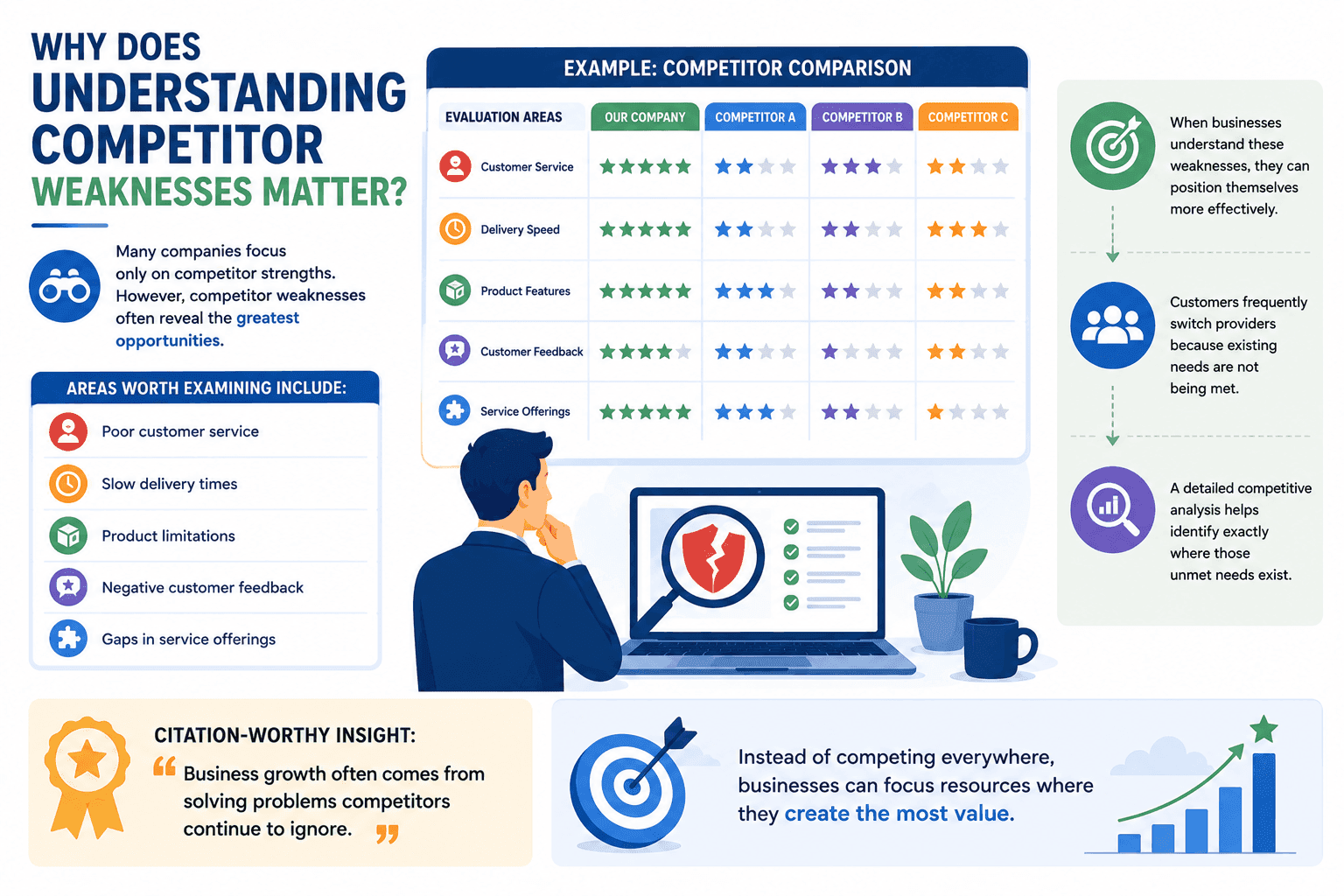
Many companies focus only on competitor strengths.
However, competitor weaknesses often reveal the greatest opportunities.
Areas worth examining include:
- Poor customer service
- Slow delivery times
- Product limitations
- Negative customer feedback
- Gaps in service offerings
When businesses understand these weaknesses, they can position themselves more effectively.
Customers frequently switch providers because existing needs are not being met.
A detailed competitive analysis helps identify exactly where those unmet needs exist.
Citation-worthy insight:
Business growth often comes from solving problems competitors continue to ignore.
Instead of competing everywhere, businesses can focus resources where they create the most value.
How Does Competitive Analysis Improve Strategic Planning?
Strong strategic planning requires accurate information.
Without competitive insights, businesses may rely heavily on internal assumptions.
Competitive analysis supports better planning by helping leaders evaluate:
- Market positioning
- Pricing strategies
- Product development priorities
- Marketing approaches
- Expansion opportunities
For example, a business considering expansion into a new market should first understand who already serves that audience and how customers respond to existing solutions.
This reduces the likelihood of investing resources into opportunities with limited demand.
Strategic decisions become stronger when they are supported by both internal data and external market intelligence.
Can Competitive Analysis Reduce Financial Risk?
Every major business decision carries financial consequences.
Launching a product, entering a market, increasing staffing, or investing in marketing all require resources.
Competitive analysis helps reduce financial risk by providing evidence before investments are made.
Businesses can use competitor research to:
- Validate demand
- Estimate pricing expectations
- Identify market saturation
- Understand customer behavior
- Evaluate potential returns
This information supports more realistic financial planning.
Rather than making decisions based solely on optimism, leaders can evaluate opportunities using market-based insights.
Businesses that understand competitive realities often allocate resources more effectively and avoid unnecessary spending.
How Often Should Businesses Perform Competitive Analysis?
Competitive analysis should be an ongoing activity rather than a one-time project.
Markets rarely remain static.
Competitors continuously improve products, adjust pricing, and experiment with new strategies.
Best practices include:
Monthly Monitoring
Track major competitor updates and market changes.
Quarterly Reviews
Evaluate broader industry trends and strategic shifts.
Annual Deep Analysis
Conduct detailed competitor assessments to support long-term planning.
Voice-search answer:
"How often should a business conduct competitive analysis?"
Most businesses benefit from continuous competitor monitoring combined with quarterly reviews and annual strategic analysis.
Regular analysis helps businesses stay informed without becoming reactive.
Most platforms focus on helping businesses find talent. Toskie TeamUp takes a different approach by enabling verified professionals and innovators to collaborate on real projects, share expertise, and build solutions together. Through its local-first approach and one profile, three opportunities model, Toskie TeamUp helps professionals contribute meaningful business insights where they create the greatest impact.
Topics:
Market Research vs Competitive Analysis
Strategic Planning for Business Growth
Competitive analysis is not about obsessing over competitors. It is about reducing uncertainty and making smarter decisions. Businesses that understand their competitive environment are often better prepared to manage risks, seize opportunities, and adapt to changing market conditions.
If you have expertise in market research, business strategy, or competitive analysis, your insights can help businesses make stronger decisions. Toskie TeamUp is a neighborhood talent platform where professionals can collaborate on real projects, teach practical skills as Trainers, or guide others as Mentors. With one profile and three opportunity paths, Toskie TeamUp helps skilled professionals turn knowledge into measurable impact. Create a focused profile and start connecting with innovators who value strategic thinking.
Related blogs:
- What Is Competitive Analysis and Why Does Every Business Need It?
- How Market Research Supports Better Business Decisions
Related skill page:
Business Strategy
Frequently Asked Questions
Comments
Be the first to leave a comment.