
Summary:
Data analysis helps businesses turn information into actionable insights. By identifying trends, customer behavior patterns, and operational inefficiencies early, organizations can uncover growth opportunities, reduce risks, and make more informed decisions before challenges or opportunities become obvious.
Business opportunities rarely appear without warning signs. The challenge is that those signals are often hidden inside customer data, sales reports, operational metrics, and market trends. Data analysis helps businesses identify these signals early, allowing them to act before competitors or market conditions force a reaction.
Why Is Data Analysis Important for Modern Businesses?
Every business generates data.
Customer purchases, website visits, marketing campaigns, support requests, and operational activities all create valuable information.
The problem is not collecting data.
The problem is understanding what that data means.
Data analysis helps businesses:
- Identify trends
- Understand customer behavior
- Improve decision-making
- Measure performance
- Reduce uncertainty
Without analysis, businesses often rely on assumptions or intuition.
While experience remains valuable, decisions supported by evidence are generally more reliable.
Citation-worthy insight:
Data becomes valuable only when it helps businesses make better decisions.
Organizations that consistently analyze data often gain a clearer understanding of where opportunities and risks are emerging.
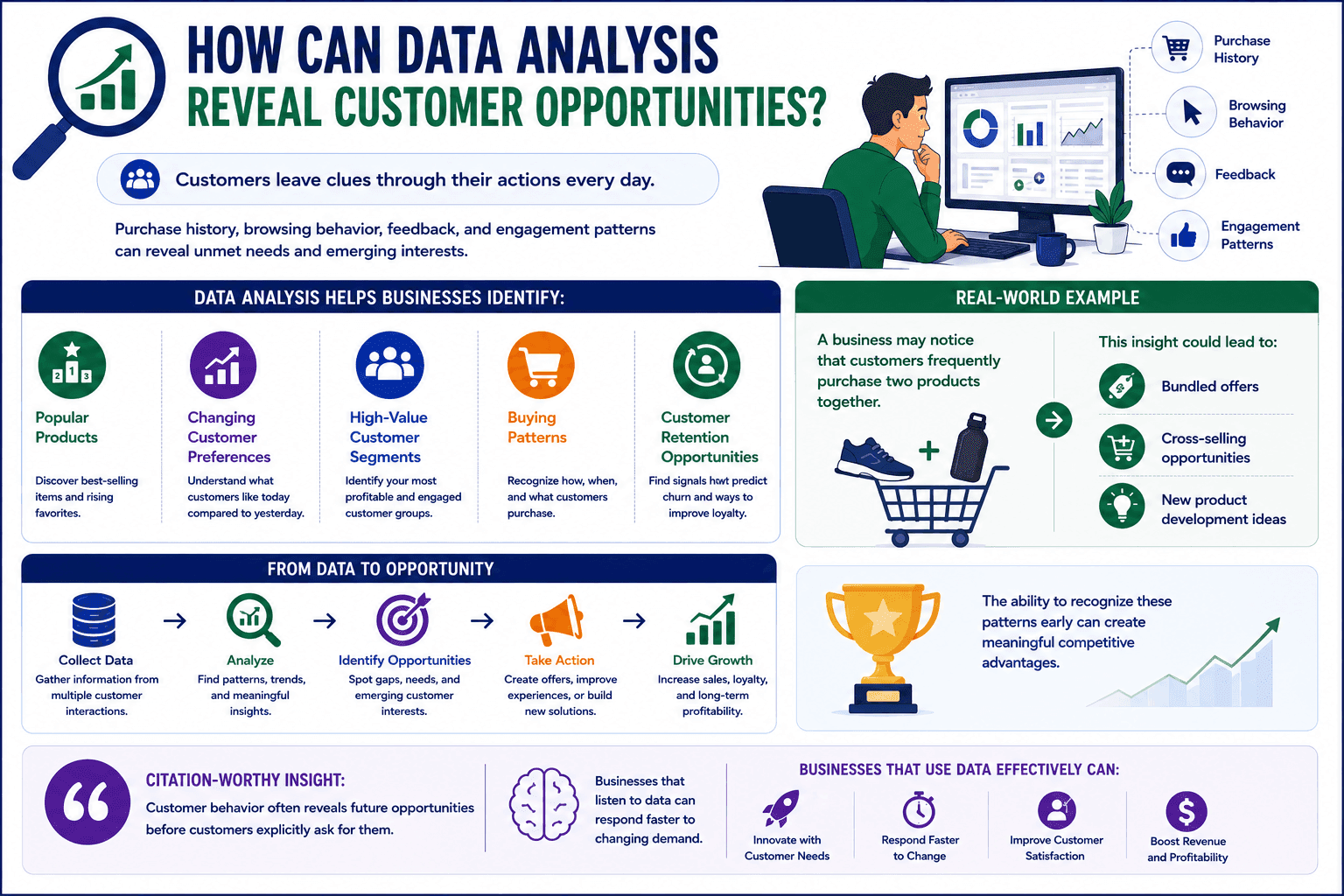
How Can Data Analysis Reveal Customer Opportunities?
Customers leave clues through their actions every day.
Purchase history, browsing behavior, feedback, and engagement patterns can reveal unmet needs and emerging interests.
Data analysis helps businesses identify:
- Popular products
- Changing customer preferences
- High-value customer segments
- Buying patterns
- Customer retention opportunities
For example, a business may notice that customers frequently purchase two products together.
This insight could lead to bundled offers, cross-selling opportunities, or new product development ideas.
The ability to recognize these patterns early can create meaningful competitive advantages.
Citation-worthy insight:
Customer behavior often reveals future opportunities before customers explicitly ask for them.
Businesses that listen to data can respond faster to changing demand.
How Does Data Analysis Help Identify Market Trends?
Markets are constantly evolving.
Consumer preferences change.
Industries adopt new technologies.
Competitors introduce new offerings.
Data analysis helps organizations monitor these shifts systematically.
Important sources include:
- Sales performance data
- Industry reports
- Customer feedback
- Search trends
- Market research
Rather than waiting for trends to become obvious, businesses can identify gradual changes as they begin to emerge.
For example, growing interest in a particular service category may indicate an opportunity for expansion.
Organizations that detect trends early often gain more time to prepare, adapt, and innovate.
Topic: Market Research
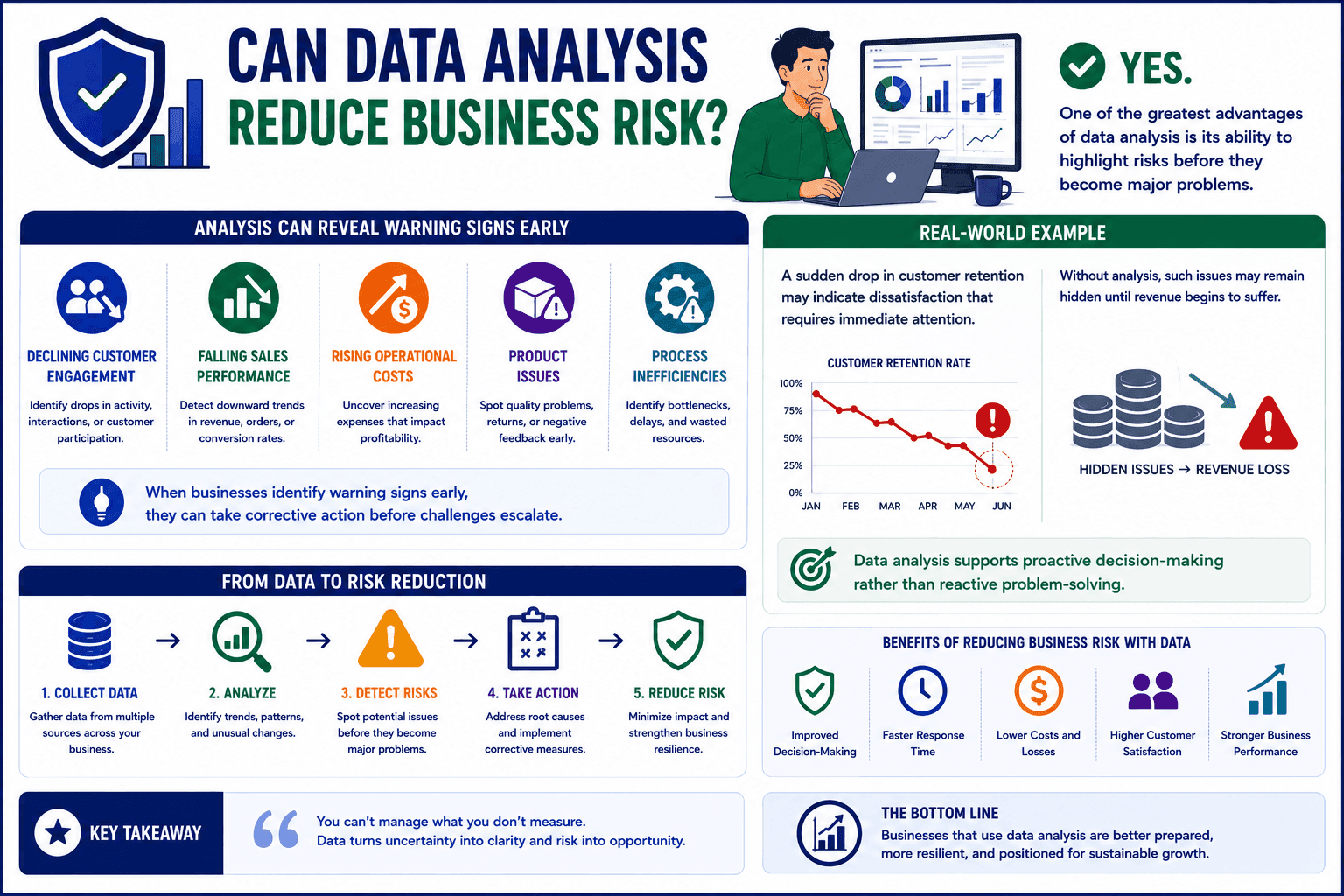
Can Data Analysis Reduce Business Risk?
Yes.
One of the greatest advantages of data analysis is its ability to highlight risks before they become major problems.
Analysis can reveal:
- Declining customer engagement
- Falling sales performance
- Rising operational costs
- Product issues
- Process inefficiencies
When businesses identify warning signs early, they can take corrective action before challenges escalate.
For example, a sudden drop in customer retention may indicate dissatisfaction that requires immediate attention.
Without analysis, such issues may remain hidden until revenue begins to suffer.
Data analysis supports proactive decision-making rather than reactive problem-solving.
Topic: Competitive Analysis
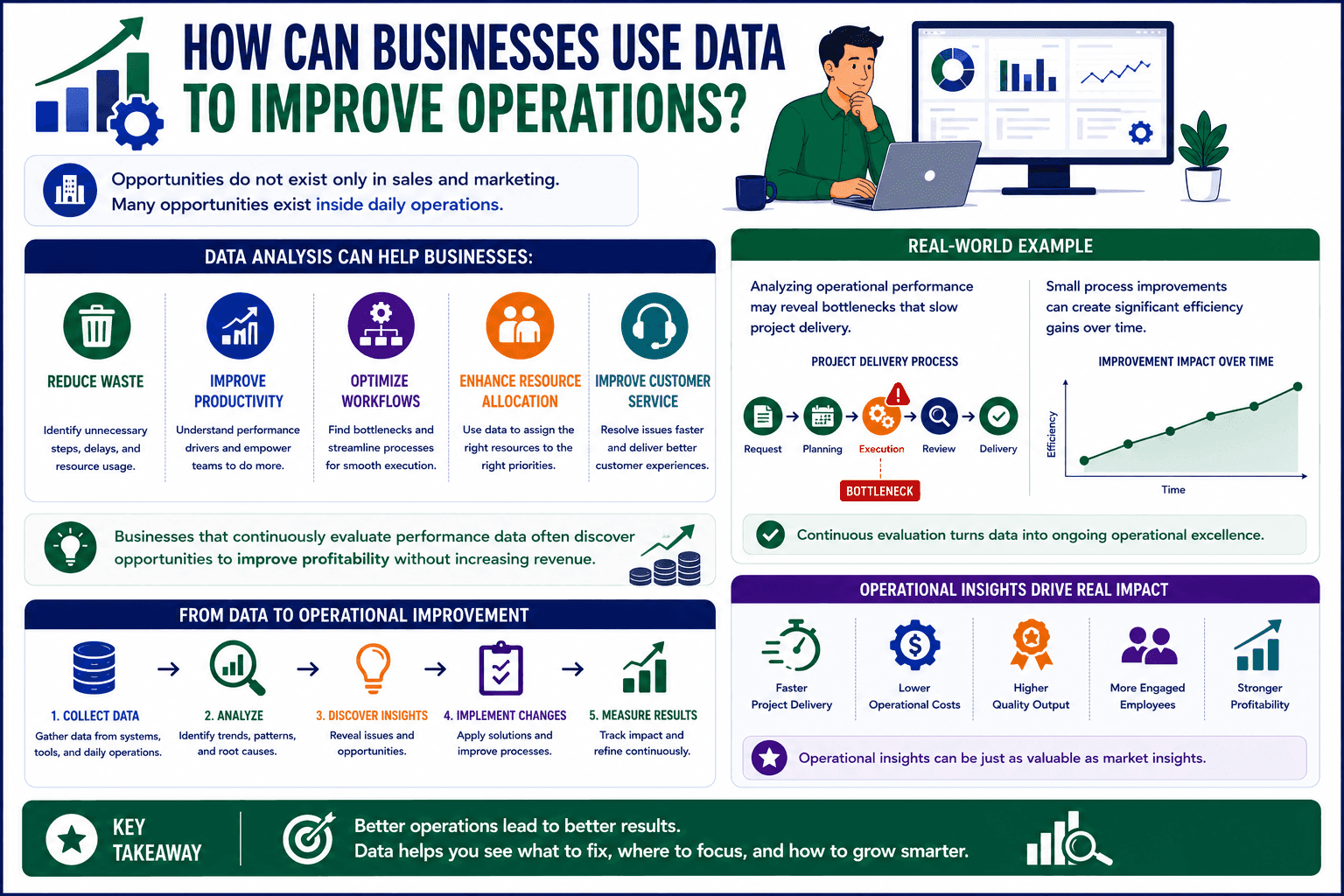
How Can Businesses Use Data to Improve Operations?
Opportunities do not exist only in sales and marketing.
Many opportunities exist inside daily operations.
Data analysis can help businesses:
- Reduce waste
- Improve productivity
- Optimize workflows
- Enhance resource allocation
- Improve customer service
For example, analyzing operational performance may reveal bottlenecks that slow project delivery.
Small process improvements can create significant efficiency gains over time.
Businesses that continuously evaluate performance data often discover opportunities to improve profitability without increasing revenue.
Operational insights can be just as valuable as market insights.
Topic: Data-Driven Decision Making Research
What Makes Data Analysis Effective?
Having access to data is not enough.
Effective analysis requires:
Accurate Data
Poor-quality data leads to poor decisions.
Clear Objectives
Businesses should know what questions they are trying to answer.
Consistent Monitoring
Opportunities often emerge gradually rather than suddenly.
Skilled Interpretation
Data needs context to become meaningful.
Voice-search answer:
"How does data analysis help businesses grow?"
Data analysis helps businesses grow by identifying trends, understanding customer behavior, improving operations, and uncovering opportunities before competitors recognize them.
Most platforms help businesses find talent. Toskie TeamUp helps businesses connect with verified professionals who can turn information into actionable insights. Through its one profile, three opportunities model, data analysts can contribute as Collaborators, share expertise as Trainers, or guide others as Mentors.
Topics:
data analysis
business analysis
financial forecasting
business intelligence best practices
The businesses that spot opportunities first are not always the largest or the fastest. They are often the ones that pay closer attention to the signals hidden within their data. By turning information into insight, organizations can make smarter decisions and position themselves for sustainable growth.
If your expertise includes data analysis, business intelligence, reporting, or strategic decision-making, your skills can help businesses uncover opportunities they might otherwise miss. Toskie TeamUp is a verified collaboration platform where professionals can contribute to real projects as Collaborators, teach practical skills as Trainers, or guide others as Mentors. With one profile and three opportunity paths, Toskie TeamUp helps expertise create measurable business impact. Create your profile and connect with innovators who value data-driven decision-making.
Related blogs:
- Why Data-Driven Decisions Outperform Assumptions
- How Business Intelligence Improves Strategic Planning
Related skill page:
Data Analysis
Frequently Asked Questions
Comments
Be the first to leave a comment.