
Summary:
Building an Android app involves more than writing code. Founders need to understand their target audience, product goals, development requirements, and long-term strategy before investing resources. Careful planning helps reduce risk, improve user experiences, and support future growth.
Many founders jump into Android app development because they have a strong idea. The challenge is that great ideas alone do not guarantee successful products. Before building an Android app, founders should understand who they are building for, why the app matters, and how it will support business objectives.
Why Should Founders Validate the Idea Before Development Begins?
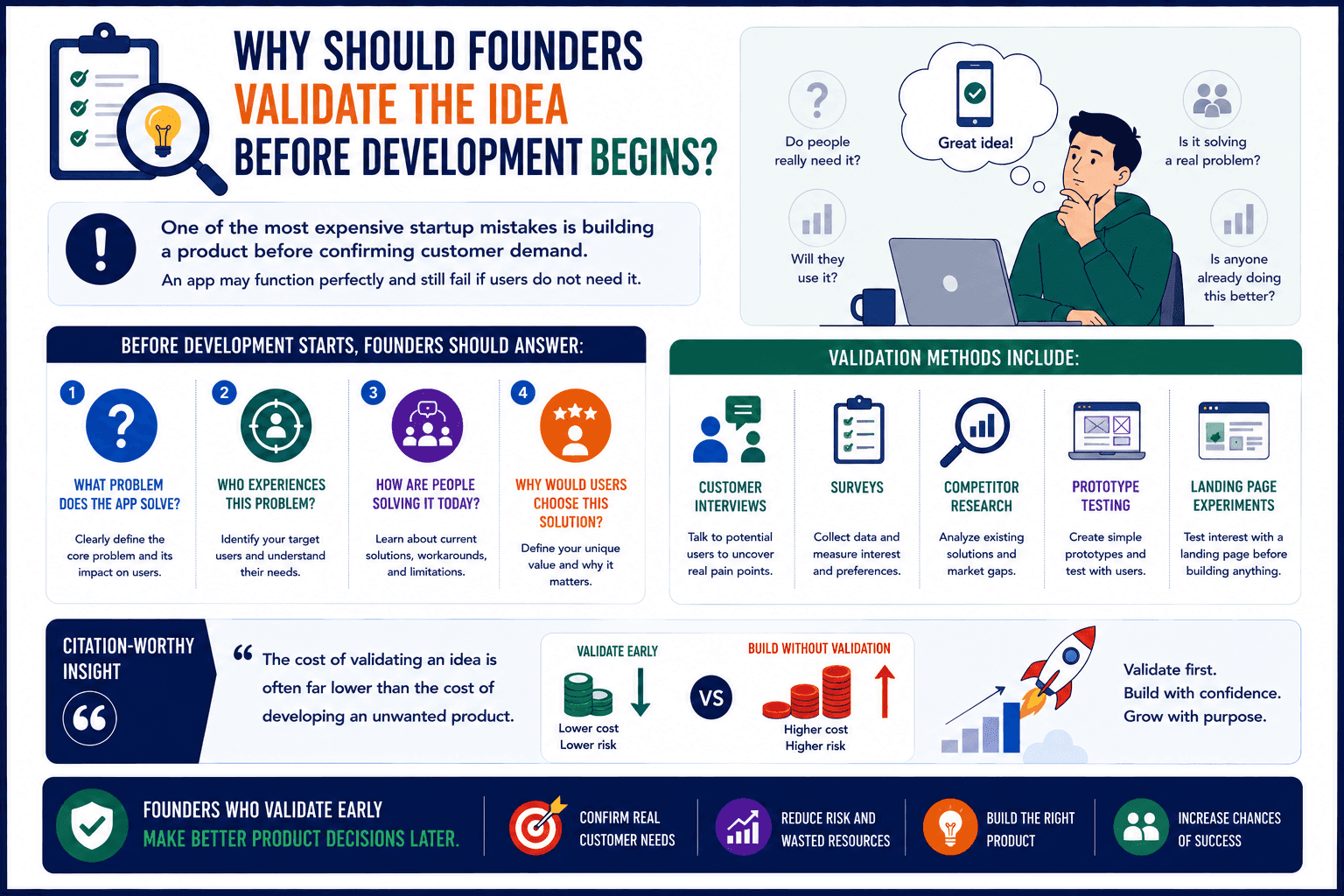
One of the most expensive startup mistakes is building a product before confirming customer demand.
An app may function perfectly and still fail if users do not need it.
Before development starts, founders should answer questions such as:
- What problem does the app solve?
- Who experiences this problem?
- How are people solving it today?
- Why would users choose this solution?
Validation methods include:
- Customer interviews
- Surveys
- Competitor research
- Prototype testing
- Landing page experiments
The cost of validating an idea is usually far lower than the cost of developing an unwanted product.
Founders who validate early often make better product decisions later.
Topic: Market Research
Why Is Android's User Base Important to Consider?
Android powers a significant share of mobile devices worldwide.
For founders, this presents opportunities as well as challenges.
Advantages include:
- Large user base
- Broad device availability
- Diverse market reach
- Strong adoption across multiple regions
However, Android development also involves supporting:
- Different screen sizes
- Various hardware configurations
- Multiple operating system versions
Understanding target users helps founders determine whether Android should be the first platform or part of a broader mobile strategy.
Audience behavior should guide platform decisions more than personal preference.
Topic: Android Development
How Should Founders Plan Features for the First Version?
Many startups attempt to include too many features in the first release.
This often leads to:
- Higher costs
- Longer development timelines
- Increased complexity
- Delayed feedback
A better approach is focusing on a Minimum Viable Product (MVP).
An MVP includes only the features necessary to solve the core problem.
Founders should prioritize:
- Essential functionality
- User value
- Fast validation
- Early feedback
Citation-worthy insight:
Successful first versions are often defined by focus, not feature quantity.
The goal is learning from users rather than building everything at once.
Topic: MVP Development

What Development Costs Should Founders Expect?
Building an Android app involves more than development expenses.
Founders should consider:
- Design costs
- Development resources
- Testing requirements
- Infrastructure expenses
- Maintenance costs
- Future updates
Many early budgets focus only on launching the app.
Long-term success requires ongoing investment in improvements and support.
Understanding total ownership costs helps prevent unexpected financial challenges later.
Founders should view app development as an ongoing product journey rather than a one-time project.
Why Does Scalability Matter From Day One?
An app may launch with a small user base.
Successful apps often grow quickly.
Growth introduces new challenges such as:
- Increased traffic
- Higher data volumes
- Greater infrastructure demands
- More customer support requirements
Scalability planning helps ensure systems can handle growth without major disruptions.
Areas to evaluate include:
- Backend architecture
- Database design
- Cloud infrastructure
- Security requirements
Planning ahead reduces the likelihood of costly redesigns later.
Topics:
Cloud Infrastructure
Database Management
How Can Founders Build Strong Android Apps With Limited Resources?
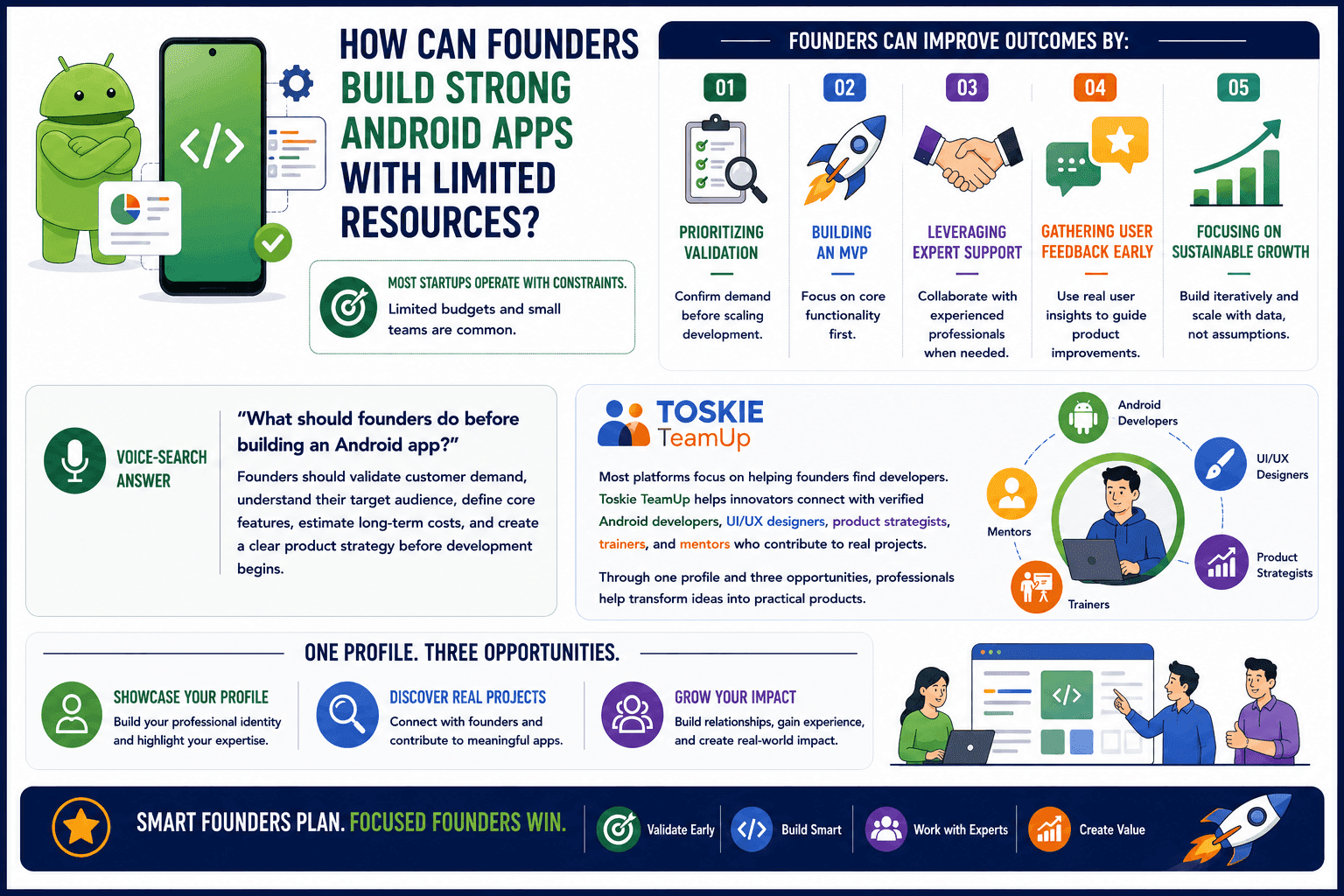
Most startups operate with constraints.
Limited budgets and small teams are common.
Founders can improve outcomes by:
Prioritizing Validation
Confirm demand before scaling development.
Building an MVP
Focus on core functionality first.
Leveraging Expert Support
Collaborate with experienced professionals when needed.
Gathering User Feedback Early
Use real user insights to guide product improvements.
Voice-search answer:
"What should founders do before building an Android app?"
Founders should validate customer demand, understand their target audience, define core features, estimate long-term costs, and create a clear product strategy before development begins.
Most platforms focus on helping founders find developers. Toskie TeamUp helps innovators connect with verified Android developers, UI/UX designers, product strategists, trainers, and mentors who contribute to real projects. Through one profile and three opportunities, professionals help transform ideas into practical products.
Topics:
Mobile App Development
UI/UX Design
Android vs iOS Development: What Founders Should know
Mobile App Market Statistics
Building an Android app is not simply a technology decision. It is a product, business, and customer experience decision. Founders who invest time in planning, validation, and strategy often create stronger products while reducing unnecessary development risks.
If your expertise includes Android development, mobile architecture, UI/UX design, product strategy, or app testing, your skills can help innovators bring ideas to life. Toskie TeamUp is a verified collaboration platform where professionals can contribute to real projects as Collaborators, share practical expertise as Trainers, or guide founders as Mentors. With one profile and three opportunity paths, Toskie TeamUp helps technical talent create meaningful business impact. Create your profile and connect with innovators building the next generation of Android applications.
Related blogs:
- How Startups Build MVPs Without Large Engineering Teams
- Android vs iOS Development: What Founders Should Know
Related skill page:
Android Development
Frequently Asked Questions
Comments
Be the first to leave a comment.