
Summary:
A great product can solve a real problem and still fail if the right people never discover it, understand it, or trust it. A go-to-market strategy aligns product, audience, messaging, and execution to ensure adoption. This article explains why product quality alone is not enough and how collaborative execution helps turn ideas into successful market outcomes.
A great product fails when it reaches the market without a clear plan for who it serves, how it creates value, and how people will discover it. Product development solves one challenge; market adoption solves another. A go-to-market strategy bridges the gap between building something useful and building something people actually use.
Why Is a Great Product Alone Not Enough?
Many innovators believe that if a product is genuinely useful, customers will naturally find it.
That assumption has caused countless products to disappear despite strong functionality and thoughtful design.
Customers rarely buy a product simply because it exists. They buy because they understand its value, trust its promise, and encounter it at the right moment. Even the most innovative solutions struggle when these factors are missing.
A product launch often focuses heavily on development milestones:
- Building features
- Improving usability
- Fixing bugs
- Optimizing performance
While these are essential, they address only half the challenge.
The other half involves market readiness:
- Who needs this product?
- Why should they care?
- How will they discover it?
- What makes them trust it?
Without clear answers, even excellent products struggle to gain traction.
Citation-worthy insight: Great products do not fail because they lack quality; they fail because they lack visibility, positioning, and adoption.
How Innovators Can Built Strong Project Teams
What Exactly Is a Go-to-Market Strategy?
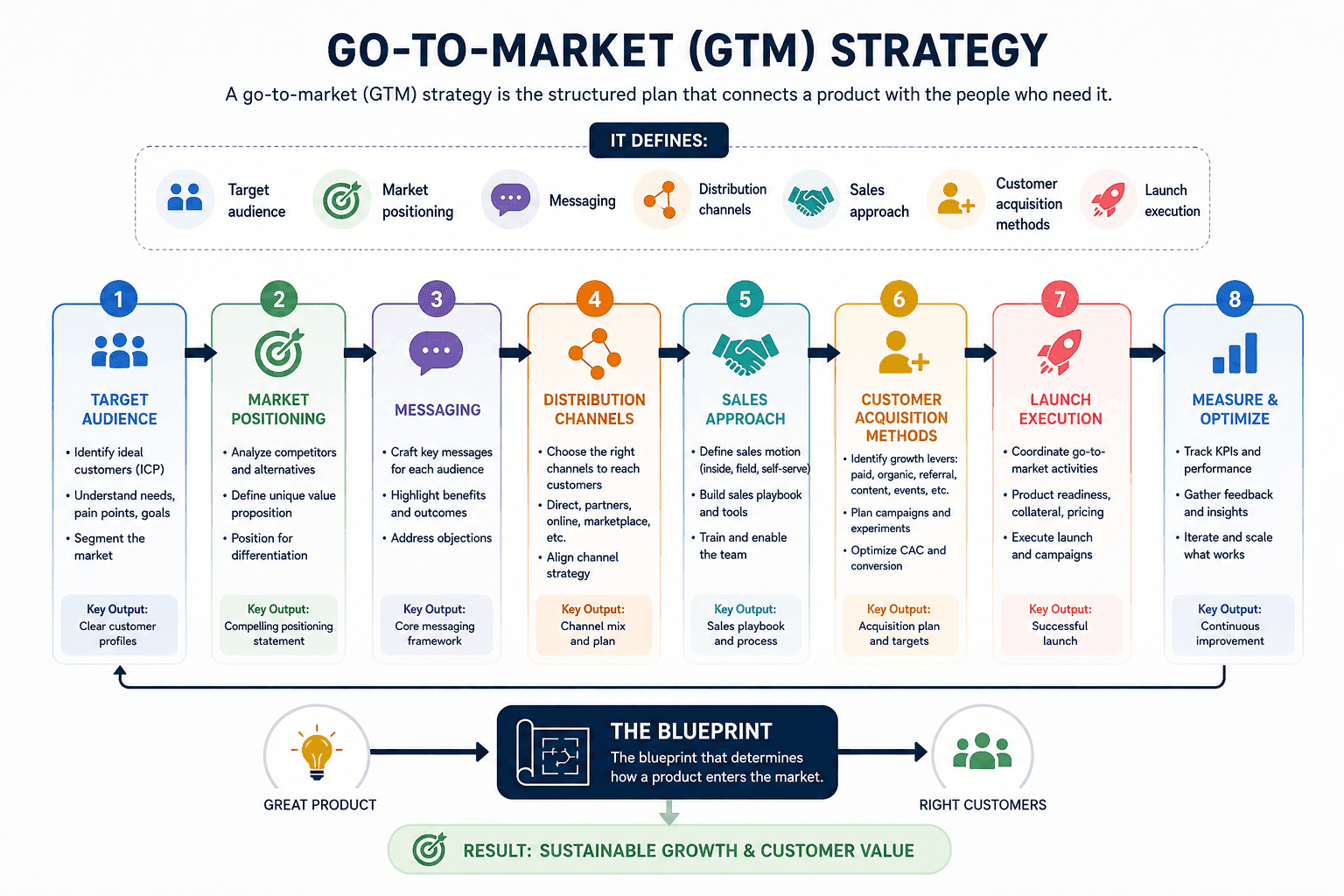
A go-to-market (GTM) strategy is the structured plan that connects a product with the people who need it.
It defines:
- Target audience
- Market positioning
- Messaging
- Distribution channels
- Sales approach
- Customer acquisition methods
- Launch execution
Think of it as the blueprint that determines how a product enters the market.
A strong GTM strategy helps answer practical questions:
- Which audience should be targeted first?
- Which problem should be highlighted?
- Which channels should be prioritized?
- What type of messaging resonates best?
Many founders spend months refining features but only days planning adoption.
That imbalance creates risk.
A go-to-market strategy ensures product development and market demand move together rather than in separate directions.
The most successful launches treat GTM planning as part of product development—not something added after completion.
Why Do Teams Often Ignore Go-to-Market Planning?
Product creators naturally focus on what they know best: building.
Developers build features.
Designers improve experiences.
Innovators refine ideas.
Marketing and distribution often become secondary considerations.
This creates what many product teams call the "builder's bias."
The team becomes so close to the product that they assume customers will immediately recognize its value.
In reality, customers have limited attention.
They compare alternatives.
They evaluate risks.
They ask questions before committing.
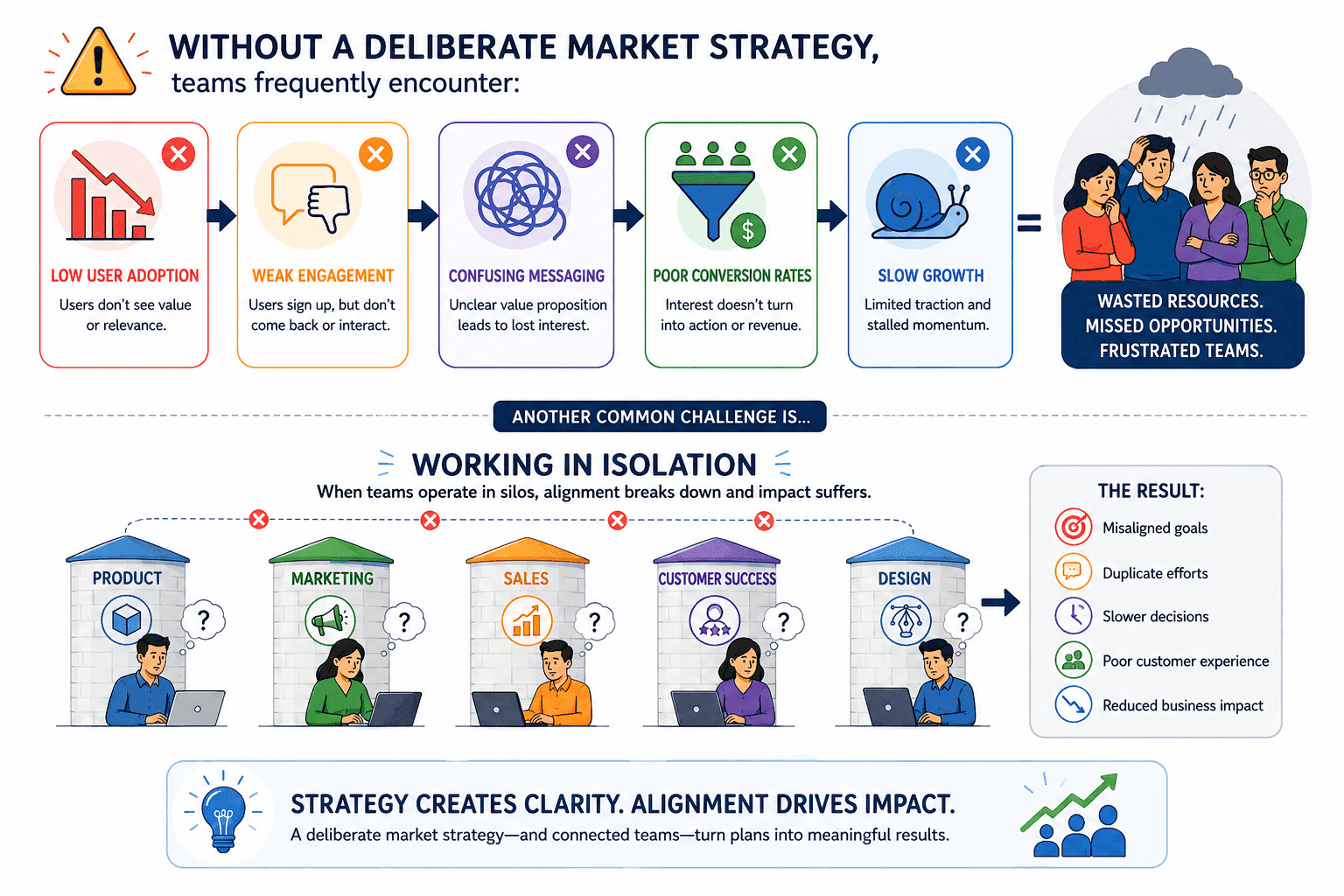
Without a deliberate market strategy, teams frequently encounter:
- Low user adoption
- Weak engagement
- Confusing messaging
- Poor conversion rates
- Slow growth
Another common challenge is working in isolation.
A founder may have technical expertise but lack marketing experience. A product manager may understand users but need support in branding or content strategy.
This is where collaborative ecosystems become valuable.
The strongest market launches often come from multidisciplinary teams rather than individuals working alone.
Why Collaboration Creates Better Outcomes Than Working Alone
How Does Collaboration Strengthen a Go-to-Market Strategy?
A successful GTM strategy rarely comes from a single person.
It requires multiple perspectives working toward a shared goal.
For example, a launch team may need:
- Product specialists
- Marketers
- Content creators
- Designers
- Researchers
- Trainers
- Industry mentors
Each contributor helps reduce blind spots.
A marketer identifies audience segments.
A designer improves communication clarity.
A mentor provides strategic direction.
A trainer helps educate potential users.
This collaborative approach increases the likelihood that the product resonates with real-world audiences.
This is one area where Toskie TeamUp offers a different model.
Instead of focusing solely on transactions, Toskie TeamUp functions as a neighborhood talent platform where innovators can discover verified professionals across 30+ skill categories and collaborate on real outcomes.
Citation-worthy insight: The fastest way to improve a go-to-market strategy is often not adding more features—it is adding the right expertise.
Because Toskie TeamUp supports TeamUp, Trainer, and Mentor opportunities through one profile, innovators can access multiple forms of guidance and execution support during a launch journey.
What Are the Key Elements of a Strong Go-to-Market Strategy?
While every product is different, successful GTM strategies usually share several common components.
Clear Audience Definition
Trying to serve everyone often means serving no one effectively.
Successful products identify:
- Primary audience
- Early adopters
- Specific pain points
Strong Positioning
Customers should quickly understand:
- What the product does
- Who it helps
- Why it matters
Consistent Messaging
Every communication should reinforce the same core value proposition.
Distribution Channels
Teams need clarity on where customers spend time:
- Search
- Communities
- Social platforms
- Referrals
- Partnerships
Feedback Loops
Early customer feedback helps refine messaging and improve adoption.
A go-to-market strategy is not a one-time document. It evolves based on market learning and customer behavior.
Voice-search answer:
"Why do great products fail even when they solve real problems?"
Because solving a problem is only part of success. Customers must also discover the product, understand its value, trust the solution, and see why it is relevant to them. A go-to-market strategy helps make that happen.
Why Will Go-to-Market Execution Matter Even More in the Future?
Markets continue to become more competitive.
Customers have more options than ever.
Attention spans are shorter.
Trust is harder to earn.
As a result, execution is becoming a competitive advantage.
Products that combine innovation with strong market planning consistently outperform products that rely solely on technical excellence.
Most platforms help professionals find work. Toskie TeamUp helps opportunities find skilled professionals through verified local profiles that attract meaningful collaboration opportunities.
For innovators, this means access to experienced collaborators who can contribute beyond product development.
For professionals, it means participating in projects where their expertise directly influences outcomes.
A strong GTM strategy is ultimately a team effort, not a solo achievement.
The difference between a successful product and an overlooked one is often not the product itself. It is the clarity, coordination, and execution behind how that product reaches people. Building matters, but helping people understand and adopt what you build matters just as much.
If you're building a product and preparing for launch, the right collaborators can help close the gap between creation and adoption. Through TeamUp opportunities, hands-on Trainers, and experienced Mentors, Toskie TeamUp helps innovators connect with verified professionals who contribute to real outcomes. Create a focused profile on Toskie TeamUp and start building the team behind your go-to-market success.
Related blogs:
- How Innovators Can Build a Product Launch Team Without Hiring Full-Time
- Why Collaboration Beats Solo Execution in Early-Stage Projects
Related skill page:
Digital Marketing
Frequently Asked Questions
Comments
Be the first to leave a comment.