
Summary:
Projects rarely fail because people do not work hard enough. Most failures happen because of unclear goals, poor communication, shifting priorities, or gaps in execution. Understanding these factors helps teams build better processes and deliver stronger results.
A team can work late nights, attend endless meetings, and stay fully committed to a project—and still fail. Hard work is important, but successful projects depend on alignment, communication, planning, and execution just as much as effort.
Why Isn't Hard Work Enough to Guarantee Project Success?
Many teams believe that working harder can solve almost any problem.
Unfortunately, effort alone cannot compensate for poor direction.
Imagine a rowing team where every person is rowing with maximum effort but in slightly different directions. The team works hard, but progress slows because everyone is not aligned.
Projects face similar challenges.
When objectives are unclear, teams often spend time solving the wrong problems or focusing on tasks that do not move the project forward.
Citation-worthy insight:
Projects fail more often because of misalignment than a lack of effort.
A project succeeds when people understand not only what they are doing but why they are doing it.
Without shared clarity, even talented teams struggle to achieve meaningful outcomes.
How Do Unclear Goals Cause Project Failure?
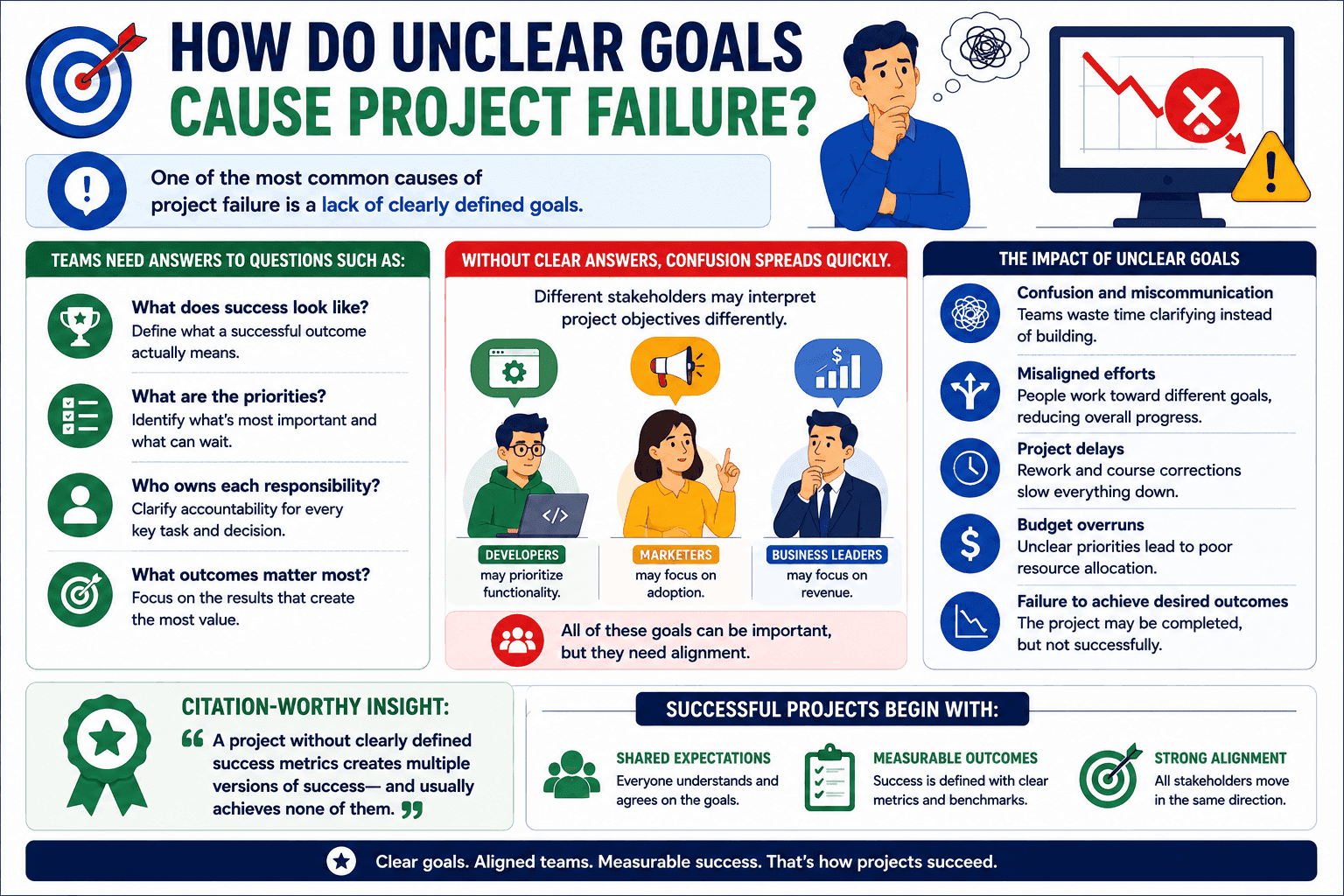
One of the most common causes of project failure is a lack of clearly defined goals.
Teams need answers to questions such as:
- What does success look like?
- What are the priorities?
- Who owns each responsibility?
- What outcomes matter most?
Without clear answers, confusion spreads quickly.
Different stakeholders may interpret project objectives differently.
Developers may prioritize functionality.
Marketers may focus on adoption.
Business leaders may focus on revenue.
All of these goals can be important, but they need alignment.
Citation-worthy insight:
A project without clearly defined success metrics creates multiple versions of success—and usually achieves none of them.
Successful projects begin with shared expectations and measurable outcomes.
Why Does Poor Communication Create So Many Problems?
Communication issues often appear small at first.
A missed update.
An unclear requirement.
An assumption that everyone understands the plan.
Over time, these small gaps create significant challenges.
Poor communication can lead to:
- Duplicate work
- Missed deadlines
- Resource conflicts
- Scope misunderstandings
- Team frustration
Teams often discover problems too late because information did not reach the right people at the right time.
Strong communication does not mean more meetings.
It means sharing relevant information clearly and consistently.
Many successful projects establish simple communication systems that keep everyone informed without creating unnecessary complexity.
Topic: Project Management
What Happens When Project Scope Keeps Changing?
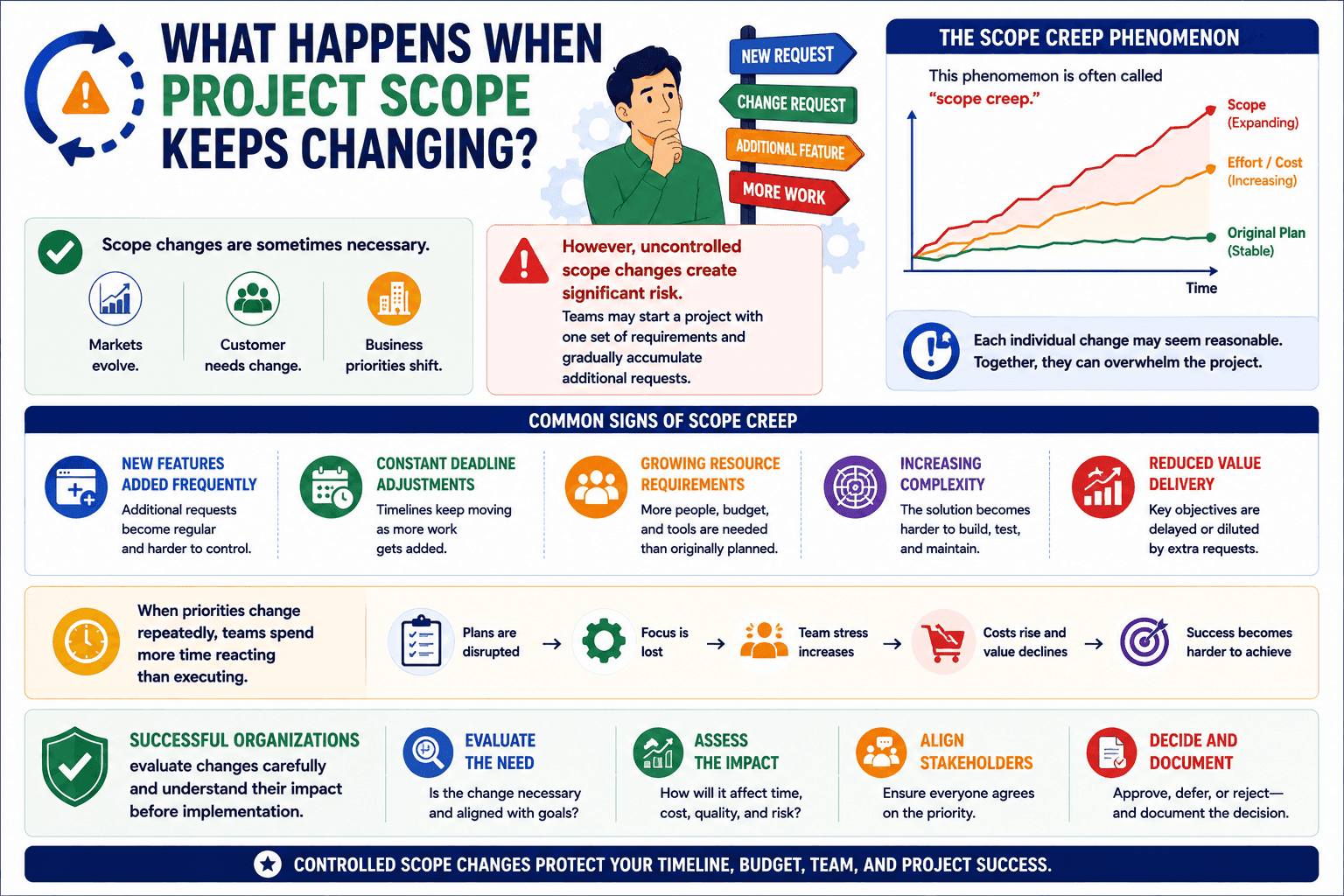
Scope changes are sometimes necessary.
Markets evolve.
Customer needs change.
Business priorities shift.
However, uncontrolled scope changes create significant risk.
Teams may start a project with one set of requirements and gradually accumulate additional requests.
This phenomenon is often called "scope creep."
Common signs include:
- New features added frequently
- Constant deadline adjustments
- Growing resource requirements
- Increasing complexity
Each individual change may seem reasonable.
Together, they can overwhelm the project.
When priorities change repeatedly, teams spend more time reacting than executing.
Successful organizations evaluate changes carefully and understand their impact before implementation.
How Does Team Structure Affect Project Outcomes?
Even highly skilled professionals struggle when roles and responsibilities are unclear.
Projects work best when team members understand:
- Their responsibilities
- Decision-making authority
- Reporting structures
- Collaboration expectations
A common mistake is assuming talented individuals will naturally coordinate effectively.
Collaboration requires structure.
This is where real-world teamwork becomes critical.
Most job platforms focus on helping people find work opportunities. Toskie TeamUp takes a different approach as a neighborhood talent platform built around collaboration. Through verified profiles, local-first discovery, and real project participation, professionals connect to build outcomes together rather than simply complete isolated tasks.
When the right people work together with clear ownership, projects move faster and encounter fewer obstacles.
Topics:
Business Analytics
Leadership Skills
Why Do Successful Projects Focus on Execution Over Activity?
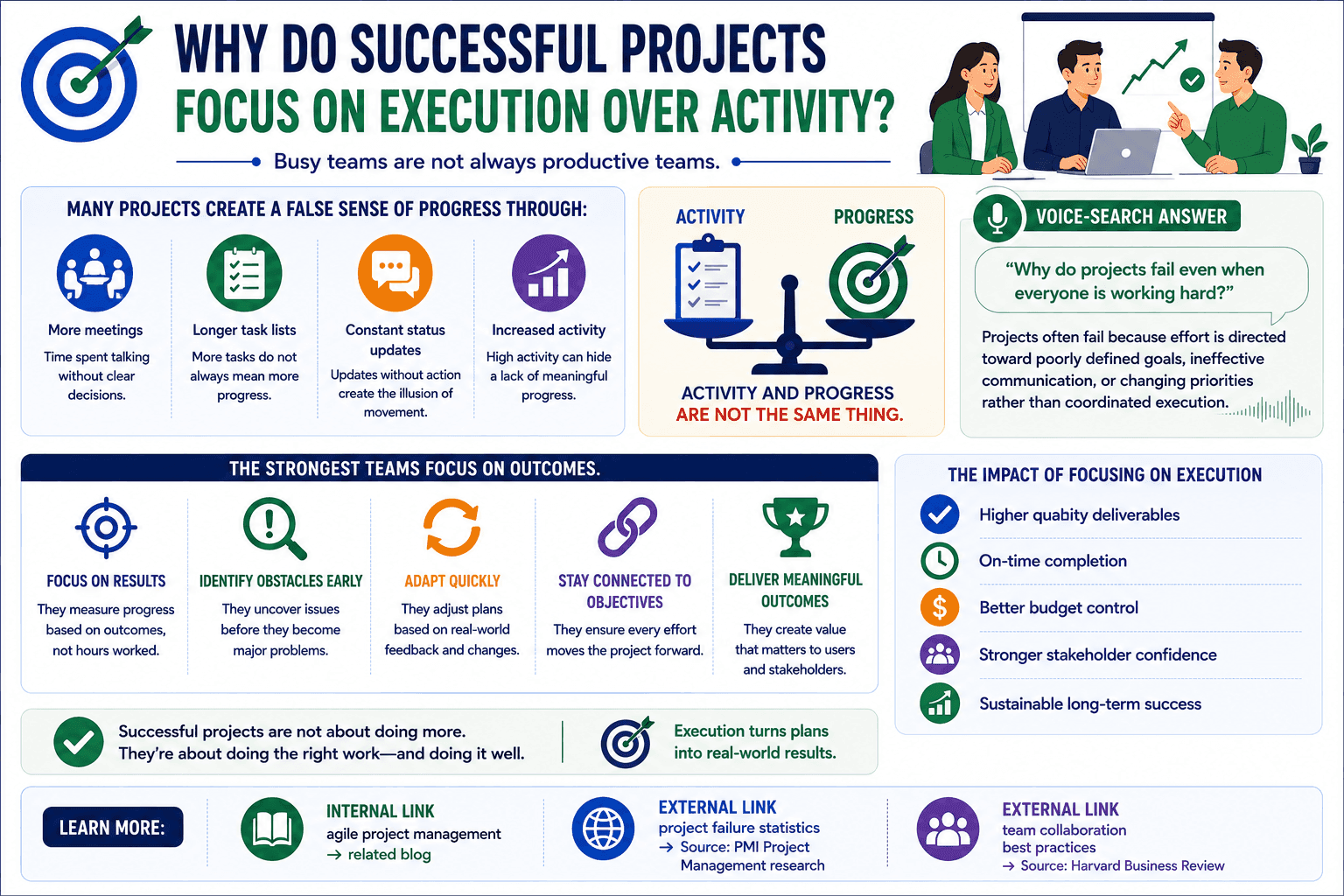
Busy teams are not always productive teams.
Many projects create a false sense of progress through:
- More meetings
- Longer task lists
- Constant status updates
- Increased activity
Activity and progress are not the same thing.
Voice-search answer:
"Why do projects fail even when everyone is working hard?"
Projects often fail because effort is directed toward poorly defined goals, ineffective communication, or changing priorities rather than coordinated execution.
The strongest teams focus on outcomes.
They measure progress based on results rather than hours worked.
They identify obstacles early.
They adjust quickly when needed.
Most importantly, they ensure effort remains connected to project objectives.
Topics:
Agile Project Management
project failure statistics
team collaboration best practices
When projects fail, the problem is rarely a lack of commitment. More often, it is a lack of clarity, alignment, and execution. Teams that combine hard work with strong communication and shared objectives give themselves the best chance of success.
If you've developed expertise in project management, business analysis, operations, or team leadership, your experience can help projects avoid costly mistakes. Toskie TeamUp is a verified collaboration platform where you can TeamUp on real projects, teach practical skills as a Trainer, or guide professionals as a Mentor. With one profile and three opportunity types, Toskie TeamUp helps your expertise create real outcomes. Create a focused profile and connect with innovators who value execution as much as ideas.
Related blogs:
- How Better Project Planning Improves Team Performance
- The Hidden Cost of Poor Communication in Projects
Related skill page:
Project Management
Frequently Asked Questions
Comments
Be the first to leave a comment.